

You may recognise several Arabic words when reading the Quran. You know what some of them mean, and perhaps you've memorised their translations.
But when you look at a complete Ayah, you might wonder how those words actually fit together.
Why does one word describe an action? Why does another refer to a person or thing? And how can something as small as one Arabic letter change the relationship between words?
This is where three basic Arabic grammar terms become useful.
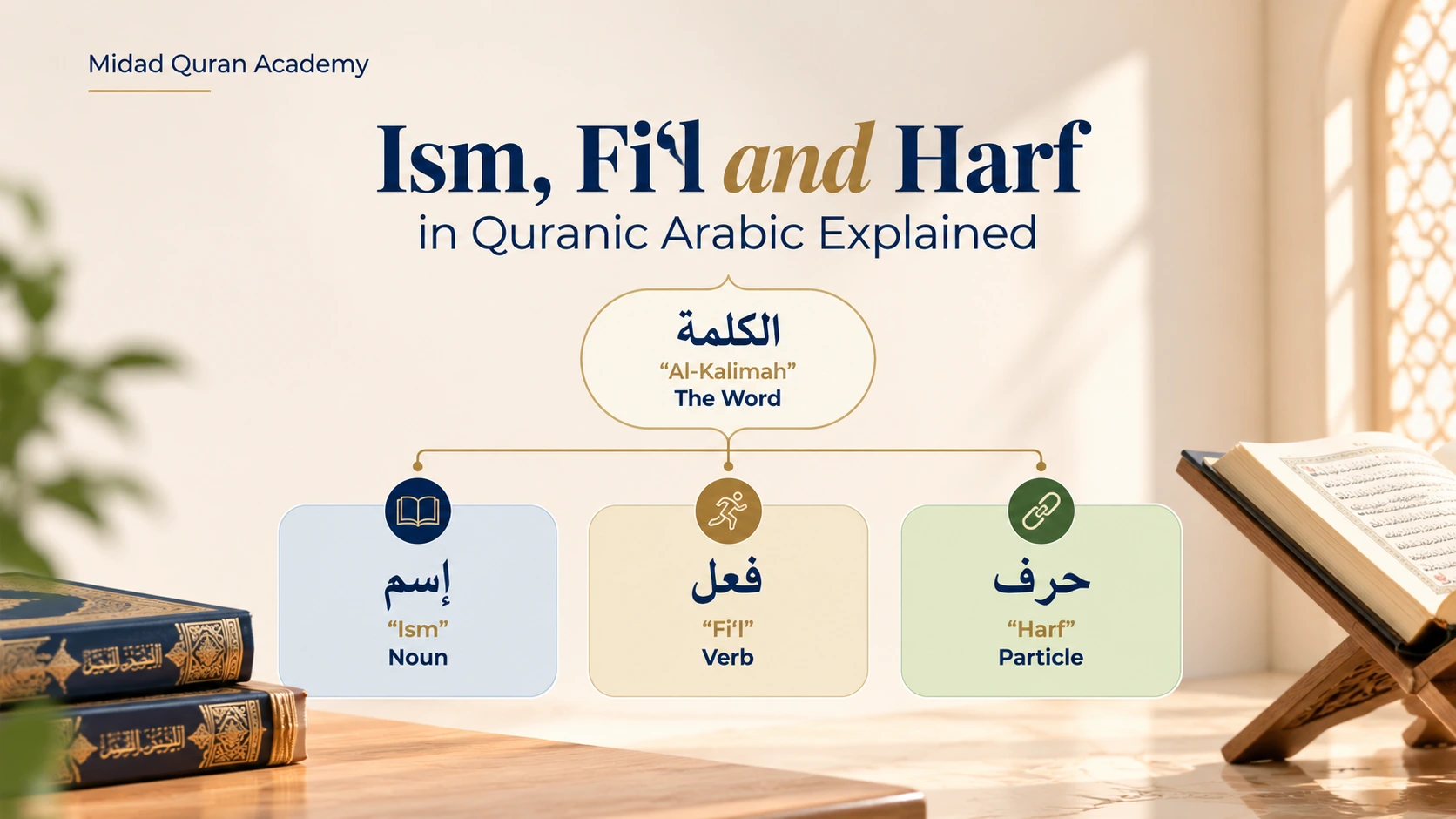
In traditional Arabic grammar, words are classified into three main categories: Ism (اِسْم), Fi‘l (فِعْل) and Harf (حَرْف). Ism includes nouns and other nominal words, Fi‘l refers to verbs, and Harf refers to grammatical particles.
Understanding these three categories is a useful first step towards recognising how Quranic Arabic sentences are formed.
Let's explore them through simple explanations and actual Quranic examples.
What Are Ism, Fi‘l and Harf?
Before looking at individual examples, here is the basic difference.
| Arabic term | Meaning | What it does |
|---|---|---|
| Ism — اِسْم | Noun or nominal word | Identifies or describes someone, something or another nominal meaning |
| Fi‘l — فِعْل | Verb | Expresses an action, event or state with a time-related grammatical meaning |
| Harf — حَرْف | Grammatical particle | Connects or affects the meaning and grammatical relationship of other words |
These are the three traditional divisions of Arabic words, known as أَقْسَامُ الْكَلِمَةِ (Aqsām al-Kalimah).
For a beginner, the purpose is not to memorise three unfamiliar labels and stop there.
It is to begin noticing what different parts of an Arabic sentence are doing.
Once you recognise that a word is an Ism, Fi‘l or Harf, you have a starting point for understanding its grammatical role.
1. Ism (اِسْم): More Than Just a Noun
The first category is Ism (اِسْم).
Beginners often learn that Ism means a noun. That's a useful introduction, but the category is broader than ordinary English nouns.
It includes common nouns, proper names, pronouns and certain descriptive words.
For example, consider:
رَبِّكَ — rabbika — your Lord
This expression appears in Surah Al-Alaq, verse 1.
The word contains:
- رَبِّ — a noun, meaning Lord.
- كَ — an attached pronoun (ضَمِير مُتَّصِل), meaning your in this context.
The pronoun also belongs to the broader Ism category in traditional Arabic grammar.
Now consider another word from the same Ayah:
الَّذِي — alladhī — who/the One who
This is a relative noun or pronoun (اِسْم مَوْصُول).
Although it does not look like an ordinary noun such as book or house, it still belongs to the Ism category.
That tells us something important.
Not every Ism simply names a physical object. The category also includes words used to refer to people, describe things and connect nominal meanings.
As you progress, you can study its further classifications, including definite and indefinite nouns, gender, number and different pronoun forms.
For now, recognising the basic category is enough.
2. Fi‘l (فِعْل): Recognising Actions and Verbs
The second category is Fi‘l (فِعْل), meaning a verb.
Arabic verbs express actions, events or states and carry grammatical information related to time.
Look at this Quranic example:
خَلَقَ — khalaqa — He created
This word appears in Surah Al-Alaq, verse 1.
It is a past-tense verb, called فِعْل مَاضٍ (Fi‘l Māḍī).
Now look at:
اِقْرَأْ — iqra' — Read/Recite
This is a command verb, called فِعْل أَمْر (Fi‘l Amr).
Both belong to the Fi‘l category, but their grammatical forms are different.
One describes an action expressed in the past. The other gives a command.
Arabic also has the imperfect verb form, الفِعْل المُضَارِع (Al-Fi‘l al-Muḍāri‘), commonly used for present or future-related meanings depending on context.
For example, in Surah Al-Fatihah, verse 5:
نَعْبُدُ — na‘budu — we worship
This is an imperfect verb.
Notice that recognising a verb involves more than finding its English translation.
As you learn further Arabic grammar, you begin recognising how a verb's form can tell you who is performing an action, and how the expression relates to time.
You don't need to master all Arabic verb conjugations to recognise the basic difference between an Ism and a Fi‘l.
Start by learning to identify familiar examples correctly.
3. Harf (حَرْف): A Small Part with an Important Role
The third category is Harf (حَرْف).
This word sometimes causes confusion because Harf can also mean a letter of the Arabic alphabet.
But in this grammar lesson, Harf means a grammatical particle, not simply an alphabet letter.
Particles include certain prepositions, conjunctions and other grammatical elements that affect how words relate to one another.
Consider the expression:
بِاسْمِ — bi-ismi — in/by the name
It appears in Surah Al-Alaq, verse 1.
Although this appears as one written expression, it contains two grammatical parts:
- بِـ — a preposition (حَرْف جَرّ) meaning in, with or by, depending on the context.
- اسْمِ — a noun (اِسْم) meaning name.
The preposition is attached to the noun in writing.
This is an important discovery for beginners: one written Arabic word can contain more than one grammatical component.
Another common particle is:
وَ — wa — and
When used as a conjunction, it is called حَرْف عَطْف (Harf ‘Aṭf).
It connects words or expressions.
Particles may be short, but they play important roles in sentence structure.
Without recognising them, a learner may know several individual vocabulary meanings and still misunderstand how a phrase is put together.
Let's Identify All Three in a Quranic Ayah
Now let's bring the categories together using one actual Quranic verse.
Surah Al-Alaq, verse 1:
اقْرَأْ بِاسْمِ رَبِّكَ الَّذِي خَلَقَ
A commonly used English rendering is:
“Recite in the name of your Lord who created.”
At first, you might look at the verse as five separate written words.
But when we examine their grammar, we can see more information.
| Quranic expression | Grammatical category | What it tells us |
|---|---|---|
| اقْرَأْ | Fi‘l (فِعْل) — command verb (فِعْل أَمْر) | A command to read or recite |
| بِـ within بِاسْمِ | Harf (حَرْف) — preposition (حَرْف جَرّ) | Introduces a grammatical relationship |
| اسْمِ within بِاسْمِ | Ism (اِسْم) — noun | Means name |
| رَبِّ within رَبِّكَ | Ism (اِسْم) — noun | Refers to the Lord |
| كَ within رَبِّكَ | Ism category — attached pronoun (ضَمِير مُتَّصِل) | Refers to the person addressed |
| الَّذِي | Ism — relative noun (اِسْم مَوْصُول) | Connects the description to its referent |
| خَلَقَ | Fi‘l (فِعْل) — past verb (فِعْل مَاضٍ) | Means created |
Notice how the categories appear together.
The verse contains verbs, nouns, a pronoun and a particle.
And some of those grammatical parts are joined together in the written Arabic.
You can check this analysis in the Quranic Arabic Corpus word-by-word explanation of 96:1.
This is where grammar becomes practical.
Instead of seeing only a sequence of words whose translation you have memorised, you begin recognising the different components and how they relate.
Of course, identifying word types is only the beginning of understanding a verse. Its full explanation and interpretation require additional knowledge and reliable Tafseer.
Three Common Mistakes to Avoid
When beginning Arabic grammar, a few misunderstandings can make learning unnecessarily difficult.
Thinking Every Ism Is an Ordinary Noun
If you learn that Ism means noun, you may initially expect every example to refer to a person, place or physical object.
But pronouns and other nominal forms also belong to this category.
So when you encounter a word such as الَّذِي, don't assume it cannot be an Ism simply because it doesn't resemble the nouns you already know.
Thinking Every Arabic Letter Is a Harf in Grammar
The word Harf has more than one meaning.
An alphabet letter is a حَرْف هِجَائِيّ (Harf Hijā'ī).
A grammatical particle is a حَرْف مَعْنًى (Harf Ma‘nā), commonly called Harf in introductory grammar.
The distinction matters.
For example, the letter ن at the beginning of نَعْبُدُ forms part of the verb's conjugation. It should not be treated as a separate preposition or conjunction merely because it is one Arabic letter.
Assuming Every Written Word Has Only One Part
Remember بِاسْمِ.
It contains both a particle and a noun.
Similarly, رَبِّكَ includes a noun and an attached pronoun.
As you study Quranic Arabic, you will encounter many expressions containing attached grammatical components.
Learning to separate those components is one step towards understanding the sentence more accurately.
Try This Short Quranic Arabic Exercise
Let's practise with another familiar Ayah.
Surah Al-Fatihah, verse 5:
إِيَّاكَ نَعْبُدُ وَإِيَّاكَ نَسْتَعِينُ
Before looking at the answers, try identifying the grammatical categories.
Which parts are verbs (Fi‘l — فِعْل)? Which are nominal words (Ism — اِسْم)? And can you find the particle (Harf — حَرْف)?
Check Your Answers
| Part | Category | Explanation |
|---|---|---|
| إِيَّاكَ | Ism (اِسْم) | A pronoun (ضَمِير) |
| نَعْبُدُ | Fi‘l (فِعْل) | An imperfect verb (فِعْل مُضَارِع), meaning we worship |
| وَ | Harf (حَرْف) | A conjunction (حَرْف عَطْف), meaning and |
| إِيَّاكَ | Ism (اِسْم) | The pronoun appears again |
| نَسْتَعِينُ | Fi‘l (فِعْل) | An imperfect verb (فِعْل مُضَارِع), meaning we seek help |
Notice that وَ is joined to the following pronoun in the written verse.
That doesn't make them the same grammatical category.
If you correctly recognised the two verbs and the attached conjunction, you've already practised an important beginning skill.
The Quranic Arabic Corpus analysis of Al-Fatihah 1:5 provides a detailed reference for this exercise.
How Should Adults Begin Learning These Three Categories?
If you're new to Quranic Arabic grammar, don't try to learn every noun type, verb form and particle rule immediately.
A more manageable approach is to work through one category at a time.
Begin by recognising simple examples of Ism (اِسْم).
Then learn a few common grammatical particles (Harf — حَرْف), particularly those that appear attached to nouns.
After that, practise identifying basic verbs (Fi‘l — فِعْل), including their past, imperfect and command forms.
Once these distinctions become familiar, you can begin examining how the words fit together into meaningful phrases and sentences.
This is also the progression established in Midad Quran Academy's planned adult Quranic Arabic curriculum.
The learning pathway begins with the three main word types, moves into their forms and functions, and later develops sentence structure, common Quranic vocabulary and practical analysis of verses.
Its purpose is not simply to teach students to memorise grammar terminology. Learners should be able to identify and use the concepts in suitable unfamiliar examples.
This Quranic Arabic course is being prepared as a future offering; it is not yet a published course page.
Understanding Word Types Is a Beginning, Not the Whole Journey
Recognising Ism, Fi‘l and Harf will not automatically make you understand every Quranic Ayah.
Vocabulary, word endings, sentence relationships and context are also important.
For example, knowing that خَلَقَ is a verb helps you understand one part of its grammatical role. But explaining the full meaning of the Ayah requires looking at how the sentence is constructed and, where appropriate, consulting reliable Tafseer.
This is why Quranic Arabic grammar and Quran Tafseer are related but distinct subjects.
Arabic grammar helps you examine the language. Tafseer provides grounded scholarly explanation of Quranic meaning and context.
If you're still developing your ability to read Arabic script, Midad's Quran Reading classes focus on those reading foundations. For learners interested in the fuller meanings and explanations of the Quran, our Quran Tafseer programme addresses that different learning goal.
For now, remember the three categories:
Ism (اِسْم) — nominal words. Fi‘l (فِعْل) — verbs. Harf (حَرْف) — grammatical particles.
When you begin recognising these parts within Quranic expressions, you take a meaningful first step towards understanding how the Arabic language works.
