

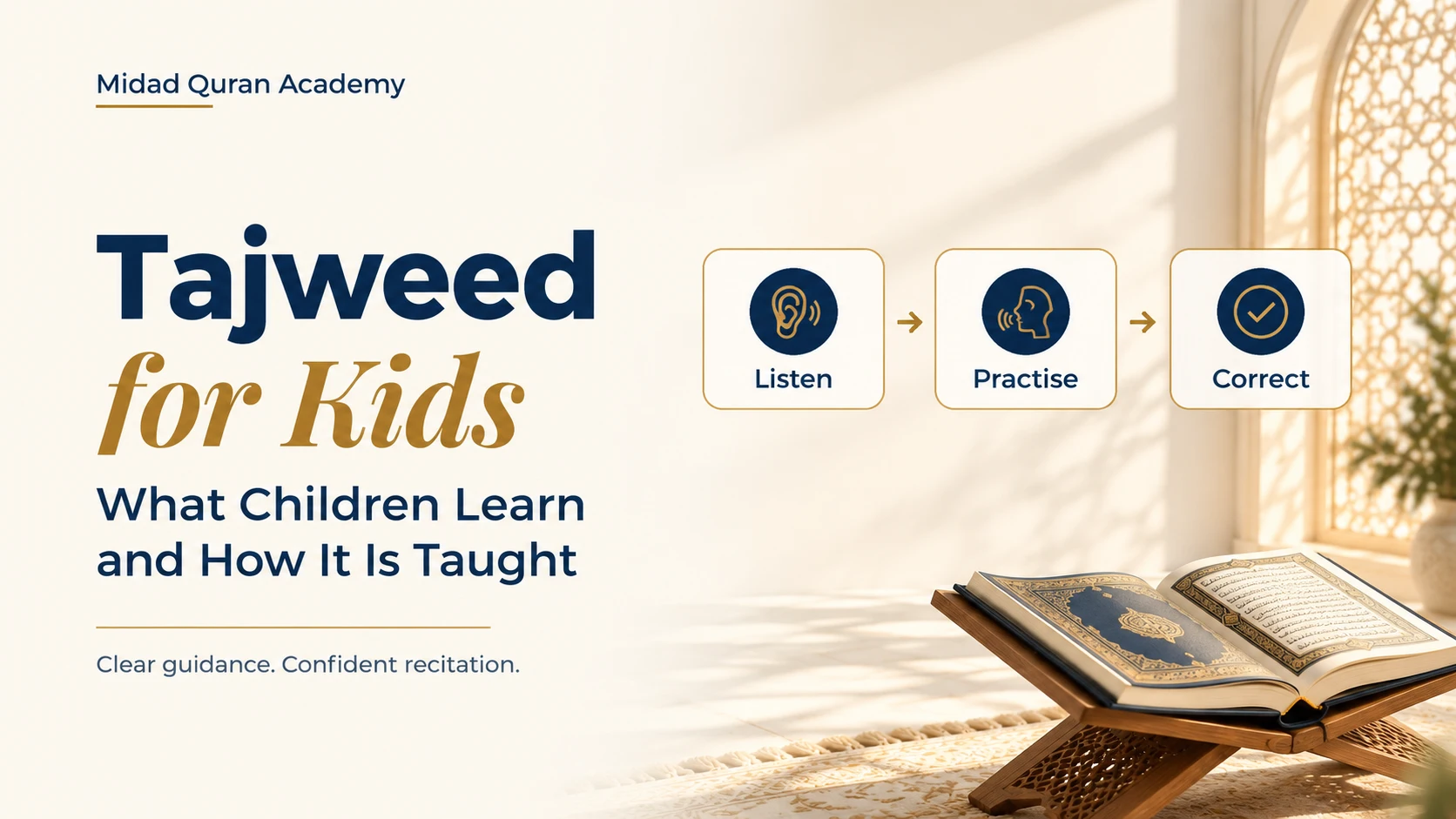
Tajweed helps children pronounce Quranic letters correctly and apply recitation rules, including lengthening, nasal sounds and appropriate stopping. For young learners, the goal is not to memorise a long list of Arabic terms. It is to hear the right sound, practise it, accept correction and gradually use it while reading the Quran.
Your child might recognise Arabic words but confuse similar letters. Perhaps they shorten a sound that should be lengthened, or pause in the middle of a phrase. These are the kinds of difficulties a teacher can work on through careful Tajweed practice.
But does every child need a separate Tajweed course? And what can parents do without becoming pronunciation teachers themselves?
What Does Tajweed Mean?
Tajweed refers to the principles of correct Quranic recitation. It includes giving Arabic letters their appropriate sounds, understanding where they are articulated, applying rules that affect pronunciation and lengthening, and learning suitable ways to stop and resume.
The Quran instructs believers to recite in a measured manner in Surah Al-Muzzammil 73:4. For a child, that message can be taught through unhurried, attentive practice rather than pressure to read quickly.
A child has not mastered a Tajweed rule simply by remembering its name. They need to recognise when it applies and begin using it reliably in recitation.
Why Do Children Need Tajweed Support?
Arabic contains sounds that some children do not use in their everyday language. A learner may be able to recognise a written letter but still need help producing it correctly.
For example, a child might confuse س and ص. These letters are not pronounced the same way; the teacher needs to demonstrate the difference and listen to the child's attempt. Other common areas for practice include letter lengthening, nasal sounds and where to pause.
Corrections are a normal part of learning. The aim is to notice recurring mistakes before they become familiar habits.
Practical Tajweed aims to help a child notice the difference, practise the correct form and apply it when encountering the sound again. Progress may be gradual, and different children need different kinds of support.
What Are Makharij, and Why Do They Matter?
Makharij (مخارج الحروف) are the articulation points used to produce Arabic letters. In simple language: where does the sound come from, and what should the mouth or throat do?
Some letters involve the lips; others require particular positions of the tongue or throat. Ghunnah (غُنَّة) adds an important nasal sound in particular Tajweed cases.
A teacher might practise one pair at a time, such as س / ص or ت / ط, asking the child to listen, watch a demonstration when helpful and attempt each sound.
Children need an age-appropriate explanation, a demonstration and guided correction—not an anatomy lecture.
Six Tajweed Topics Children May Meet as They Progress
These are examples of common topics, not a syllabus to complete all at once. A teacher selects what suits the child.
1. Madd (المد) — Lengthening a Sound
Madd concerns lengthening vowel sounds under particular conditions. In قَالَ, the Alif represents a long vowel. For natural Madd (المد الطبيعي), the length is normally two counts in the Hafs recitation taught at Midad Quran Academy.
The teacher helps the child avoid shortening or overstretching the vowel.
2. Ghunnah (غُنَّة) — Nasal Resonance
Ghunnah is a nasal sound that is clearly heard in cases such as Noon or Meem with Shaddah. For example, إِنَّا in Surah Al-Kawthar 108:1 provides a familiar instance.
A demonstration helps the child practise without adding an extra vowel or exaggerating the sound.
3. Qalqalah (قلقلة) — A Brief Release of Certain Letters
Qalqalah concerns the letters ق ط ب ج د when they are in a state of Sukoon. It has a distinct released or ‘bouncing’ quality, not an added vowel.
When stopping on أَحَدٌ in Surah Al-Ikhlas 112:1, the final Daal is read with Sukoon and the relevant Qalqalah sound. This needs a live demonstration.
4. Noon Sakinah and Tanween (النون الساكنة والتنوين)
These lead to several rules depending on the letter that follows. Four basic classifications are:
| Rule | Beginner explanation | Quranic example |
|---|---|---|
| Izhar (إظهار) | Pronounce Noon Sakinah/Tanween clearly before the relevant throat letters. | مِنْ هَادٍ — 13:33 |
| Idgham (إدغام) | Merge the Noon sound into the next letter in the relevant cases. | فَمَن يَعْمَلْ — 99:7; the Noon meets Yaa |
| Iqlab (إقلاب) | Before Baa, the Noon/Tanween sound changes to a Meem-like nasal sound. | سَمِيعٌ بَصِيرٌ — 22:75, shown here in simplified teaching notation |
| Ikhfa (إخفاء) | Conceal the Noon sound with the appropriate nasal quality before specified letters. | مِنْ شَرِّ — 113:2 |
Arabic examples here use simplified classroom spelling where appropriate. Some Mushaf editions show additional recitation symbols, including an Iqlab sign. A qualified teacher should check the exact printed text and demonstrate each example in its full context.
A child should learn the rule currently being taught—not all four in one lesson.
5. Heavy and Light Pronunciation
The letters خ ص ض غ ط ق ظ have a heavier quality (Tafkhim — تفخيم) in relevant contexts. Children learn to distinguish these from lighter sounds.
The teacher can use short comparisons, but the child should not be expected to fix a difficult sound through written instructions alone.
6. Stopping and Starting — Waqf and Ibtida
Waqf (وقف) concerns stopping during recitation, while Ibtida (ابتداء) concerns beginning or resuming. Children gradually learn common stopping signs and how to avoid stopping at a place that leaves a phrase unclear.
The aim is careful reading, not rushing to finish an Ayah.
How Should a Teacher Teach Tajweed to a Child?
The most useful sequence is simple: demonstrate, identify, practise, correct and revisit.
Suppose the teacher notices that a child repeatedly confuses س and ص.
First, the teacher produces both sounds clearly. Next, the child practises them in a short word or suitable Quranic example. The teacher listens and gives a precise correction, perhaps explaining what to change about the tongue or the quality of the sound.
Once the child can produce the sound with support, the teacher checks it again within a complete Ayah. In a later class, the teacher returns to the skill to see whether the improvement has continued.
That last step matters. Saying a sound correctly once is encouraging, but reliable recitation develops through practice and review.
For children, correction should be calm and specific. Rather than pointing out every small difficulty at once, the teacher can prioritise the mistakes that matter most for the learner's current level.
Does Your Child Need Qaida, Quran Reading or Practical Tajweed?
Not every child who makes a pronunciation mistake needs a dedicated Tajweed course. The starting point depends on the foundation already in place.
| If your child currently… | A sensible starting direction |
|---|---|
| Has difficulty recognising letters, reading signs or joining words | Noorani Qaida to strengthen the reading foundation |
| Recognises Arabic words but needs more fluency and ordinary pronunciation correction | Quran Reading with foundational Tajweed applied during recitation |
| Can read Quranic text sufficiently and wants to study rules more systematically | Practical Tajweed with explanation, identification and application |
These paths are connected. A child can receive basic Tajweed correction during Qaida and Quran Reading. More structured Practical Tajweed instruction is appropriate when they have enough reading ability to apply rules in real verses.
An assessment helps avoid repeating material a child already knows—or moving them into a level for which they are not ready.
How Can Parents Support Tajweed at Home?
You don't have to know every Tajweed rule to be helpful. The teacher should guide what the child practises and what kind of correction is appropriate.
Follow one clear target. If the teacher has assigned a letter pair, a Madd sound or a short passage, begin there. Introducing several unrelated rules may make practice confusing.
Use the recitation the teacher recommends. Audio can help the child hear an accurate example, but it should match the words and method being studied.
Keep practice calm and manageable. A short, focused attempt is often easier to sustain than a long session in which the child becomes tired or upset.
Don't guess at pronunciation corrections. If you're unsure whether a sound is correct, note the word and ask the teacher rather than teaching a correction you cannot verify.
Notice effort and improvement. A child who slows down, listens carefully or notices their own mistake is developing useful habits even if the recitation is not yet consistent.
For more general advice about home routines, see our guide to supporting Quran learning without pressure.
Why Does Live Teacher Correction Matter?
Books, videos and recordings can show what correct recitation sounds like. They can be useful between lessons.
But a recording cannot listen to one particular child's attempt and say, for example, “That letter needs a different tongue position,” or “You have shortened this Madd sound.”
During a live one-to-one lesson, a teacher can hear the actual error, demonstrate a correction and check whether the next attempt improves.
Parents choosing instruction can ask how teachers are qualified, how they listen and correct, whether a learner's starting level is checked and how progress is communicated. Midad explains its approach on the Teachers and Learning System pages.
Frequently Asked Questions
At What Age Should Children Begin Tajweed?
Simple pronunciation correction can begin while a child learns Arabic letters. There is no single age at which every child must start formal Tajweed theory. The amount of explanation should match their reading skill and readiness.
Must a Child Finish Noorani Qaida Before Learning Any Tajweed?
No. Fundamental pronunciation and relevant Tajweed skills are already introduced during Qaida. A separate, more detailed Tajweed course normally suits a learner who can read Quranic words and passages well enough to apply the rules.
Can Children Learn Tajweed Online?
They can learn through live online lessons when the teacher can hear them clearly, demonstrate sounds, provide individual correction and check their progress. The child's ability to participate comfortably also matters.
How Long Does It Take to Learn Tajweed?
There is no single reliable completion time for every child. Progress depends on their starting level, the rules being studied, practice and how consistently they can apply correction.
Can Listening to Recordings Replace a Tajweed Teacher?
Recordings support listening and repetition. They do not replace individual pronunciation assessment and live feedback for a learner who still needs correction.
A Clearer Starting Point for Your Child
The purpose of Tajweed is to help a child recite the Quran more accurately. A long list of completed rules means little if the learner still cannot recognise or apply them in real Quranic reading.
Look for teaching that begins at the child's actual level, explains one manageable skill at a time and includes regular opportunities to practise and receive correction.
At Midad Quran Academy, children can learn foundational recitation through Noorani Qaida and Quran Reading, or develop their rule knowledge through one-to-one Practical Tajweed when ready.
We offer three free trial classes before payment. These give the teacher an opportunity to listen to your child's current reading, identify what needs attention and recommend a suitable learning direction.
