

Learn Noorani Qaida Online With a Clear Quran Reading Foundation.
Noorani Qaida teaches the reading basics a beginner needs before regular Quran reading: Arabic letters and their sounds, joined forms, short vowels, Sukoon, Shaddah, Madd, and simple word reading.
MIDAD’s live one-to-one online Noorani Qaida classes help children, teenagers, and adults build these skills step by step, with correction as mistakes appear and a clear move into Quran Reading when the foundation is ready.
Build Arabic letter recognition, sounds, joining, reading signs, and simple word reading through live one-to-one beginner lessons.
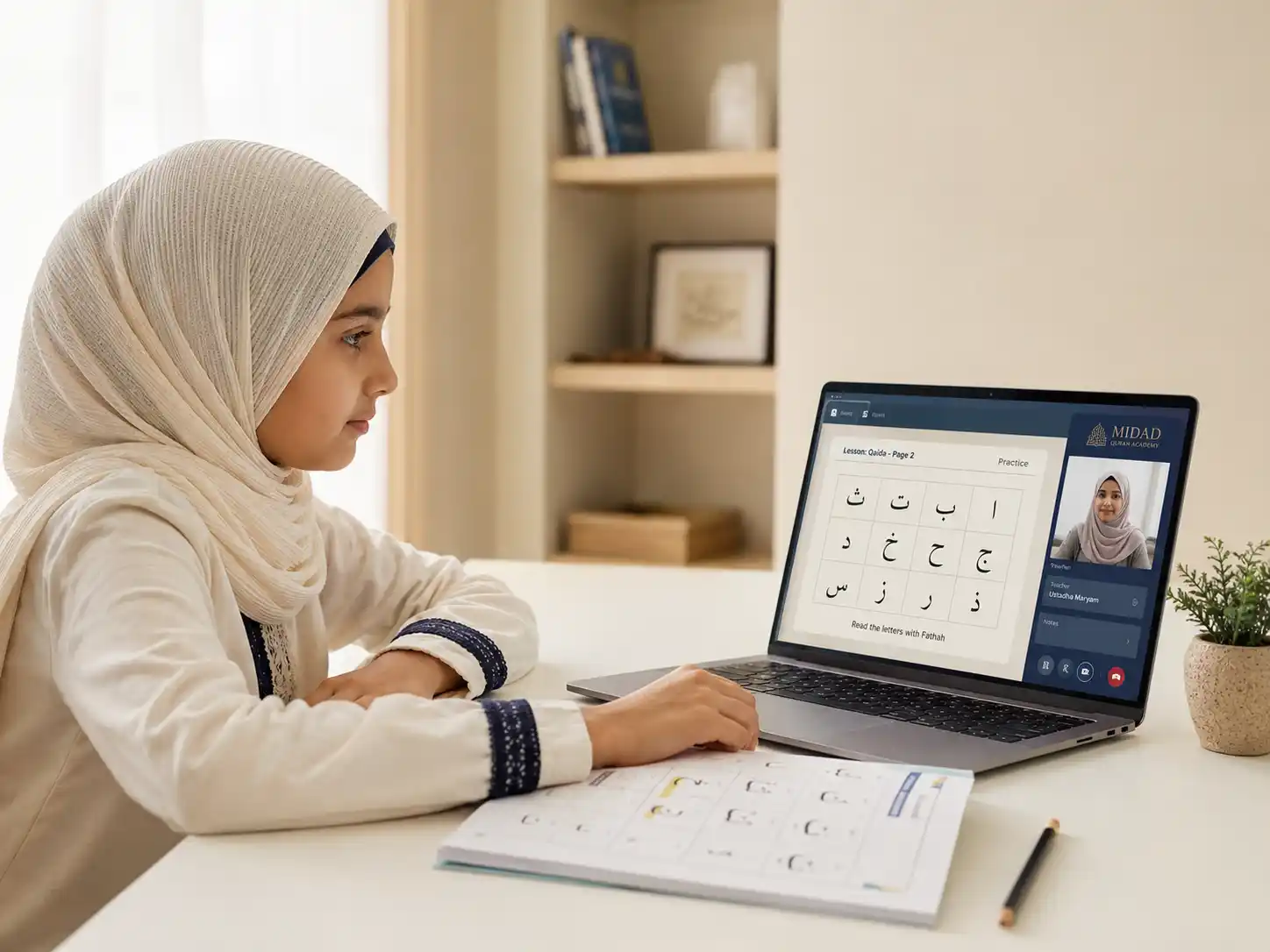
Recognise Arabic Letters
Learn similar letter shapes clearly and accurately.
Read Letter Sounds
Practise each sound carefully before joining begins.
Understand Joined Forms
See how letters connect and change shape inside words.
Apply Vowels & Signs
Use short vowels, Sukoon, Shaddah, Madd, and other basic signs.
Build Reading Readiness
Bring the basics together before moving into Quran Reading.
Live one-to-one beginner classes for Arabic letters, sounds, joining, reading signs, and simple words before Quran reading.
BEGINNER QAIDA · 1:1 ONLINEFor Beginners Who Still Need the Reading Basics.
Noorani Qaida is suitable for complete beginners and for learners who know some Arabic letters but still struggle when letters join, reading signs change, or simple words need to be read independently. Children, teenagers, and adults can all begin from the level they actually need.
Complete Beginners
For learners starting Arabic reading for the first time. They begin with letters, sounds, short vowels, and the earliest reading steps without being expected to know anything beforehand.
Learners Who Guess While Reading
For learners who recognise parts of a word but rely on memory, shape, or guessing instead of reading each letter and sign carefully.
Learners With Missing Foundations
For learners who already know some letters but become confused by joined forms, changing vowels, Sukoon, Shaddah, Madd, or simple connected words.
Older Beginners & Adults
For older children, teenagers, or adults who want to learn privately from the basics through one-to-one classes without being rushed into material they are not ready for.
If the learner can already read connected Quranic text with reasonable fluency, Quran Reading may be the better next step. If reading is already established but recitation needs deeper rule-based correction, Practical Tajweed may be more suitable. We can check the starting point during the free trial classes.
For Beginners Who Still Need the Reading Basics.
Noorani Qaida is suitable for complete beginners and for learners who know some Arabic letters but still struggle when letters join, reading signs change, or simple words need to be read independently. Children, teenagers, and adults can all begin from the level they actually need.
Complete Beginners
For learners starting Arabic reading for the first time. They begin with letters, sounds, short vowels, and the earliest reading steps without being expected to know anything beforehand.
Learners Who Guess While Reading
For learners who recognise parts of a word but rely on memory, shape, or guessing instead of reading each letter and sign carefully.
Learners With Missing Foundations
For learners who already know some letters but become confused by joined forms, changing vowels, Sukoon, Shaddah, Madd, or simple connected words.
Older Beginners & Adults
For older children, teenagers, or adults who want to learn privately from the basics through one-to-one classes without being rushed into material they are not ready for.
If the learner can already read connected Quranic text with reasonable fluency, Quran Reading may be the better next step. If reading is already established but recitation needs deeper rule-based correction, Practical Tajweed may be more suitable. We can check the starting point during the free trial classes.
NOT SURE WHERE TO START?Is Qaida the Right Starting Point?
Start with Qaida when the basic reading system is still unclear, even if some letters are already familiar.
Is Qaida the Right Starting Point?
Letters Are Still New
The learner is beginning Arabic reading from the first step.
Words Are Guessed
The learner recognises something on the page but does not read it carefully.
Joining Breaks Down
Letters look familiar alone but become confusing inside words.
Older Beginner
An older child, teenager, or adult wants to restart from the basics.
The free trial can help us check whether Qaida, Quran Reading, or Practical Tajweed is the better starting point.
Learn Noorani Qaida Online Through One Clear Reading Sequence.
Beginners learn more easily when each reading skill supports the next. The learner starts with Arabic letters and sounds, then moves through joining, reading signs, simple words, and early Quran reading readiness with teacher guidance at every stage.
Arabic Letter Recognition
Recognise Arabic letters clearly, including similar shapes that beginners commonly confuse. The learner should know what is on the page before being asked to read it quickly.
Letter Sounds
Practise the sound of each letter carefully so unclear pronunciation does not become part of the learner’s normal reading.
Joining Letters
Learn how Arabic letters connect and how their shapes can change at the beginning, middle, or end of a word.
Vowels & Reading Signs
Apply Fathah, Kasrah, Dammah, Sukoon, Shaddah, Madd, Tanween, and other basic reading signs through guided practice.
Simple Word Reading
Bring letters, sounds, joined forms, and reading signs together to read simple words with less guessing and better control.
Quran Reading Readiness
As the foundation becomes more reliable, the learner begins preparing for connected Quranic text rather than remaining dependent on isolated Qaida exercises.
Each stage should become clear enough to support the next. The goal is not to finish pages quickly, but to build a reading foundation that can carry the learner forward.
Learn Noorani Qaida Online Through One Clear Reading Sequence.
Beginners learn more easily when each reading skill supports the next. The learner starts with Arabic letters and sounds, then moves through joining, reading signs, simple words, and early Quran reading readiness with teacher guidance at every stage.
Arabic Letter Recognition
Recognise Arabic letters clearly, including similar shapes that beginners commonly confuse. The learner should know what is on the page before being asked to read it quickly.
Letter Sounds
Practise the sound of each letter carefully so unclear pronunciation does not become part of the learner’s normal reading.
Joining Letters
Learn how Arabic letters connect and how their shapes can change at the beginning, middle, or end of a word.
Vowels & Reading Signs
Apply Fathah, Kasrah, Dammah, Sukoon, Shaddah, Madd, Tanween, and other basic reading signs through guided practice.
Simple Word Reading
Bring letters, sounds, joined forms, and reading signs together to read simple words with less guessing and better control.
From First Letters to Reading Readiness.
Each skill is taught in sequence so the learner understands what comes next.
Each skill is taught in sequence so the learner understands what comes next.
Arabic Letters
Identify letters clearly, including similar shapes.
Letter Sounds
Read each sound carefully from the beginning.
Joining Letters
Understand how letters change and connect inside words.
Vowels & Reading Signs
Use vowels, Sukoon, Shaddah, Madd, and basic signs.
Simple Words
Bring letters, sounds, and signs together with less guessing.
Build enough control to begin Quran Reading when the foundation is ready.
Correct Beginner Reading Mistakes Before They Become Habits.
A live one-to-one Qaida lesson lets the teacher hear exactly where reading breaks down. Letters, sounds, joining, reading signs, and guessing can be corrected as they appear instead of being carried quietly into later Quran reading.
Letter Confusion
Similar Arabic letters can be mixed up because of their shape or dots. The learner is taught to notice the difference and identify each letter before moving on.
Sound Mistakes
Unclear or mixed letter sounds are corrected early so the learner does not repeatedly practise the wrong sound.
Joining Confusion
A learner may recognise letters separately but lose track of them when they connect. Joined forms are broken down and practised until the pattern becomes easier to follow.
Missed Reading Signs
Short vowels, Sukoon, Shaddah, Madd, Tanween, and other basic marks can change how a word is read. The learner is taught to notice and apply them rather than skip over them.
Guessing Instead of Reading
Some beginners try to recognise a word from memory or overall shape. We slow the reading down and bring attention back to the actual letters and signs on the page.
Low Confidence
Frequent mistakes can make a beginner hesitant to read aloud. Clearer foundations and manageable practice help the learner become more willing to read independently.
Correct what is unclear, practise it carefully, and make the next reading step easier.
Correct Beginner Reading Mistakes Before They Become Habits.
A live one-to-one Qaida lesson lets the teacher hear exactly where reading breaks down. Letters, sounds, joining, reading signs, and guessing can be corrected as they appear instead of being carried quietly into later Quran reading.
Letter Confusion
Similar Arabic letters can be mixed up because of their shape or dots. The learner is taught to notice the difference and identify each letter before moving on.
Sound Mistakes
Unclear or mixed letter sounds are corrected early so the learner does not repeatedly practise the wrong sound.
Joining Confusion
A learner may recognise letters separately but lose track of them when they connect. Joined forms are broken down and practised until the pattern becomes easier to follow.
Missed Reading Signs
Short vowels, Sukoon, Shaddah, Madd, Tanween, and other basic marks can change how a word is read. The learner is taught to notice and apply them rather than skip over them.
Guessing Instead of Reading
Some beginners try to recognise a word from memory or overall shape. We slow the reading down and bring attention back to the actual letters and signs on the page.
Small Mistakes Should Not Become Reading Habits.
Qaida is where common beginner reading mistakes should be noticed and corrected.
Correct Beginner Reading Mistakes Before They Become Habits.
Move From Noorani QAIDA TO QURAN READING When the Foundation Is Ready.
Qaida is preparation for Quran reading, not a race to finish a book. The learner is ready to move forward when letters, joined forms, reading signs, and simple words can be handled with less guessing and less teacher support.
Letters Are Recognised Reliably
The learner identifies Arabic letters without repeatedly stopping, mixing similar shapes, or depending on prompts.
Reading Signs Are Applied More Carefully
Short vowels, Sukoon, Shaddah, Madd, and other basic signs are noticed instead of being skipped or guessed.
Joined Words Make More Sense
The learner can follow how letters connect and read simple combinations without needing every word broken apart.
Guessing Becomes Less Common
Reading starts to come from the letters and signs on the page rather than memory, word shape, or hidden help.
Independent Reading Begins to Grow
The learner can attempt simple reading with better control and can respond to correction without losing the whole word.
Noorani Qaida builds the reading system. Quran Reading uses that system across connected Quranic text.
Move From Noorani Qaida to Quran Reading When the Foundation Is Ready.
Qaida is preparation for Quran reading, not a race to finish a book. The learner is ready to move forward when letters, joined forms, reading signs, and simple words can be handled with less guessing and less teacher support.
Letters Are Recognised Reliably
The learner identifies Arabic letters without repeatedly stopping, mixing similar shapes, or depending on prompts.
Reading Signs Are Applied More Carefully
Short vowels, Sukoon, Shaddah, Madd, and other basic signs are noticed instead of being skipped or guessed.
Joined Words Make More Sense
The learner can follow how letters connect and read simple combinations without needing every word broken apart.
Guessing Becomes Less Common
Reading starts to come from the letters and signs on the page rather than memory, word shape, or hidden help.
Independent Reading Begins to Grow
The learner can attempt simple reading with better control and can respond to correction without losing the whole word.
Move Forward When the Foundation Is Ready.
The goal is not to finish Qaida quickly. The goal is to make the learner ready for the next reading stage.
Readiness signals
The learner begins to use the reading system with less guessing and less help.
Qaida builds the foundation. Quran Reading puts it into regular use.
Know the Standards Behind Every Noorani Qaida Class.
Beginner teaching needs more than showing a page and asking the learner to repeat it. MIDAD checks teacher qualifications and beginner-teaching ability, supervises classes live, and keeps the learner’s progress visible.
Qualified Quran Teachers
Teachers are Hafiz-e-Quran, with relevant Quran and Tajweed qualifications and supporting documents reviewed before regular teaching.Hafiz-e-Quran with relevant documents reviewed.
Beginner Teaching Assessed
Knowledge of Arabic letters, sounds, joining, reading signs, beginner correction, and the ability to explain these skills step by step are checked before assignment.Qaida knowledge, pronunciation, correction, and beginner teaching checked.
Live Class Supervision
Classes sit within MIDAD’s live-supervision system to support responsible, patient, and consistent one-to-one teaching.Classes sit within MIDAD’s live-supervision system.
Progress Visibility
Adult learners can follow their own progress, while parents of younger learners receive clear updates about what was practised, what is improving, which basics remain weak, and what should be reviewed next.Know what is improving and which basics still need work.
Clear Standards. Visible Progress.
You should know how the learner is being taught, which reading skills are becoming stronger, and what still needs attention before moving forward.Know how the learner is being taught, what is stronger, and what still needs attention.
Know What Supports Every Qaida Class.
Teacher checks, beginner-teaching assessment, live supervision, and visible progress support the learning system.
Teacher checks, beginner-teaching assessment, live supervision, and visible progress support the learning system.
Start Noorani Qaida at the Learner’s Real Level.
Tell us what the learner can already recognise and read. We’ll use the three free trial classes to check letters, sounds, joining, reading signs, and the right starting point.
Book 3 Free Qaida Trial Classes
Share a few details about the learner’s current reading level and learning needs.
Clear Monthly Pricing for Online Noorani Qaida Classes.
Choose two, three, or five live one-to-one Qaida classes each week. Every lesson is 30 minutes, and you can start with three free trial classes before choosing a paid plan.
3. Choose classes per week
30-minute live one-to-one classes5 Days / Week
Five 45-minute one-to-one classes each week for memorisation, revision, listening, and correction.
3 days per week · 30-minute one-to-one classes
Questions About Noorani Qaida Online & Beginner Classes
Find clear answers about who should start Noorani Qaida, what beginners learn, how online lessons work, class routine, progress, the move into Quran Reading, and the three free trial classes.
Noorani Qaida is for complete beginners and learners whose Arabic reading foundation is still weak. It is suitable when letters, sounds, joined forms, reading signs, or simple words cannot yet be read reliably without considerable help.
No. A learner can begin without previous Arabic reading experience. Noorani Qaida starts with Arabic letters and basic sounds before gradually introducing joined forms, vowels, reading signs, and simple words.
Yes. Children, teenagers, and adult beginners can all learn Noorani Qaida. The starting point should depend on the learner’s current reading ability and previous experience rather than age alone.
The learner works through Arabic letter recognition, letter sounds, joined forms, short vowels, Sukoon, Shaddah, Madd, Tanween, other basic reading signs, and simple word reading. These skills prepare the learner for regular Quran Reading.
If you are looking for Noorani Qaida online classes at home, MIDAD lessons are live and one-to-one. The teacher explains the current reading skill, listens to the learner apply it, corrects mistakes as they appear, gives guided practice, and makes the next lesson depend on what is actually understood.
Returning to Qaida can be useful when letters, joining, reading signs, or simple word reading remain weak. The goal is not to move the learner backwards, but to repair the missing foundation so Quran Reading can become more manageable.
Noorani Qaida teaches the reading system itself: letters, sounds, joined forms, vowels, signs, and simple combinations. Quran Reading uses those skills across connected Quranic text while developing greater fluency, accuracy, and reading confidence.
Important beginner pronunciation and reading mistakes are corrected during Qaida, but Noorani Qaida is not a full rule-based Tajweed course. Learners who can already read and need deeper work on Makharij, Tajweed rules, and precise recitation correction may be better suited to Practical Tajweed.
There is no responsible fixed completion time for every learner. Progress depends on the starting level, age, reading confidence, class frequency, practice between lessons, and how securely each stage is understood before the learner moves forward.
MIDAD offers Noorani Qaida routines of two, three, or five classes per week. Each regular class is a live 30-minute one-to-one lesson. Families or adult learners can choose the routine that fits their availability and learning needs.
Progress is based on what the learner can actually recognise and read, not simply how many Qaida pages have been covered. We keep attention on letters, sounds, joining, reading signs, simple word reading, recurring mistakes, and the next skill that needs work.
The learner can begin moving into Quran Reading when Arabic letters are recognised reliably, basic reading signs are applied with reasonable consistency, joined words make more sense, and simple reading can be attempted with less guessing and less support.
The learner joins three live one-to-one classes before enrolment. We use the trials to understand the current reading level, begin from an appropriate lesson, observe how the learner responds to correction, and identify the next learning priority. No payment is required before the trial.
Questions About Noorani Qaida Online & Beginner Classes
Find clear answers about who should start Noorani Qaida, what beginners learn, how online lessons work, class routine, progress, the move into Quran Reading, and the three free trial classes.
Noorani Qaida is for complete beginners and learners whose Arabic reading foundation is still weak. It is suitable when letters, sounds, joined forms, reading signs, or simple words cannot yet be read reliably without considerable help.
No. A learner can begin without previous Arabic reading experience. Noorani Qaida starts with Arabic letters and basic sounds before gradually introducing joined forms, vowels, reading signs, and simple words.
Yes. Children, teenagers, and adult beginners can all learn Noorani Qaida. The starting point should depend on the learner’s current reading ability and previous experience rather than age alone.
The learner works through Arabic letter recognition, letter sounds, joined forms, short vowels, Sukoon, Shaddah, Madd, Tanween, other basic reading signs, and simple word reading. These skills prepare the learner for regular Quran Reading.
If you are looking for Noorani Qaida online classes at home, MIDAD lessons are live and one-to-one. The teacher explains the current reading skill, listens to the learner apply it, corrects mistakes as they appear, gives guided practice, and makes the next lesson depend on what is actually understood.
Returning to Qaida can be useful when letters, joining, reading signs, or simple word reading remain weak. The goal is not to move the learner backwards, but to repair the missing foundation so Quran Reading can become more manageable.
Noorani Qaida teaches the reading system itself: letters, sounds, joined forms, vowels, signs, and simple combinations. Quran Reading uses those skills across connected Quranic text while developing greater fluency, accuracy, and reading confidence.
Important beginner pronunciation and reading mistakes are corrected during Qaida, but Noorani Qaida is not a full rule-based Tajweed course. Learners who can already read and need deeper work on Makharij, Tajweed rules, and precise recitation correction may be better suited to Practical Tajweed.
There is no responsible fixed completion time for every learner. Progress depends on the starting level, age, reading confidence, class frequency, practice between lessons, and how securely each stage is understood before the learner moves forward.
MIDAD offers Noorani Qaida routines of two, three, or five classes per week. Each regular class is a live 30-minute one-to-one lesson. Families or adult learners can choose the routine that fits their availability and learning needs.
Progress is based on what the learner can actually recognise and read, not simply how many Qaida pages have been covered. We keep attention on letters, sounds, joining, reading signs, simple word reading, recurring mistakes, and the next skill that needs work.
The learner can begin moving into Quran Reading when Arabic letters are recognised reliably, basic reading signs are applied with reasonable consistency, joined words make more sense, and simple reading can be attempted with less guessing and less support.
The learner joins three live one-to-one classes before enrolment. We use the trials to understand the current reading level, begin from an appropriate lesson, observe how the learner responds to correction, and identify the next learning priority. No payment is required before the trial.
Questions Before Starting Qaida
Quick answers about level, lessons, progress, Quran Reading readiness, and the free trial.
01 Who Should Start With Noorani Qaida? −
Noorani Qaida is for complete beginners and learners whose Arabic reading foundation is still weak. It is suitable when letters, sounds, joined forms, reading signs, or simple words cannot yet be read reliably without considerable help.
02 Does the Learner Need to Know Arabic Before Starting? +
No. A learner can begin without previous Arabic reading experience. Noorani Qaida starts with Arabic letters and basic sounds before gradually introducing joined forms, vowels, reading signs, and simple words.
03 Can Children, Teenagers, and Adults Learn Noorani Qaida? +
Yes. Children, teenagers, and adult beginners can all learn Noorani Qaida. The starting point should depend on the learner’s current reading ability and previous experience rather than age alone.
04 What Does the Learner Study in Noorani Qaida? +
The learner works through Arabic letter recognition, letter sounds, joined forms, short vowels, Sukoon, Shaddah, Madd, Tanween, other basic reading signs, and simple word reading. These skills prepare the learner for regular Quran Reading.
05 How Do Online Noorani Qaida Classes Work? +
If you are looking for Noorani Qaida online classes at home, MIDAD lessons are live and one-to-one. The teacher explains the current reading skill, listens to the learner apply it, corrects mistakes as they appear, gives guided practice, and makes the next lesson depend on what is actually understood.
06 What If the Learner Has Already Started Reading the Quran but Still Struggles? +
Returning to Qaida can be useful when letters, joining, reading signs, or simple word reading remain weak. The goal is not to move the learner backwards, but to repair the missing foundation so Quran Reading can become more manageable.
07 What Is the Difference Between Noorani Qaida and Quran Reading? +
Noorani Qaida teaches the reading system itself: letters, sounds, joined forms, vowels, signs, and simple combinations. Quran Reading uses those skills across connected Quranic text while developing greater fluency, accuracy, and reading confidence.
08 Is Tajweed Taught in Noorani Qaida? +
Important beginner pronunciation and reading mistakes are corrected during Qaida, but Noorani Qaida is not a full rule-based Tajweed course. Learners who can already read and need deeper work on Makharij, Tajweed rules, and precise recitation correction may be better suited to Practical Tajweed.
09 How Long Does Noorani Qaida Take? +
There is no responsible fixed completion time for every learner. Progress depends on the starting level, age, reading confidence, class frequency, practice between lessons, and how securely each stage is understood before the learner moves forward.
10 How Often Are Noorani Qaida Classes and How Long Is Each Lesson? +
MIDAD offers Noorani Qaida routines of two, three, or five classes per week. Each regular class is a live 30-minute one-to-one lesson. Families or adult learners can choose the routine that fits their availability and learning needs.
11 How Is Noorani Qaida Progress Tracked? +
Progress is based on what the learner can actually recognise and read, not simply how many Qaida pages have been covered. We keep attention on letters, sounds, joining, reading signs, simple word reading, recurring mistakes, and the next skill that needs work.
12 When Is the Learner Ready to Move From Qaida to Quran Reading? +
The learner can begin moving into Quran Reading when Arabic letters are recognised reliably, basic reading signs are applied with reasonable consistency, joined words make more sense, and simple reading can be attempted with less guessing and less support.
13 How Do the 3 Free Noorani Qaida Trial Classes Work? +
The learner joins three live one-to-one classes before enrolment. We use the trials to understand the current reading level, begin from an appropriate lesson, observe how the learner responds to correction, and identify the next learning priority. No payment is required before the trial.
Try Noorani Qaida Before You Choose a Regular Plan.
Join three live one-to-one trial classes for yourself or your child. We’ll check the current reading level, begin from an appropriate Qaida lesson, and show how teaching, practice, and correction work before you decide whether to continue.
The trial can also help us see whether Noorani Qaida, Quran Reading, or Practical Tajweed is the more suitable starting point.
Try Noorani Qaida Before You Choose a Regular Plan.
Join three live one-to-one trial classes for yourself or your child. We’ll check the current reading level, begin from an appropriate Qaida lesson, and show how teaching, practice, and correction work before you decide whether to continue.
No payment before the trial. Experience the teaching first and decide afterward.
Try the Qaida Classes First.
See the learner’s starting level and experience the one-to-one teaching before choosing a regular plan.
No payment first. Decide after the trial.