

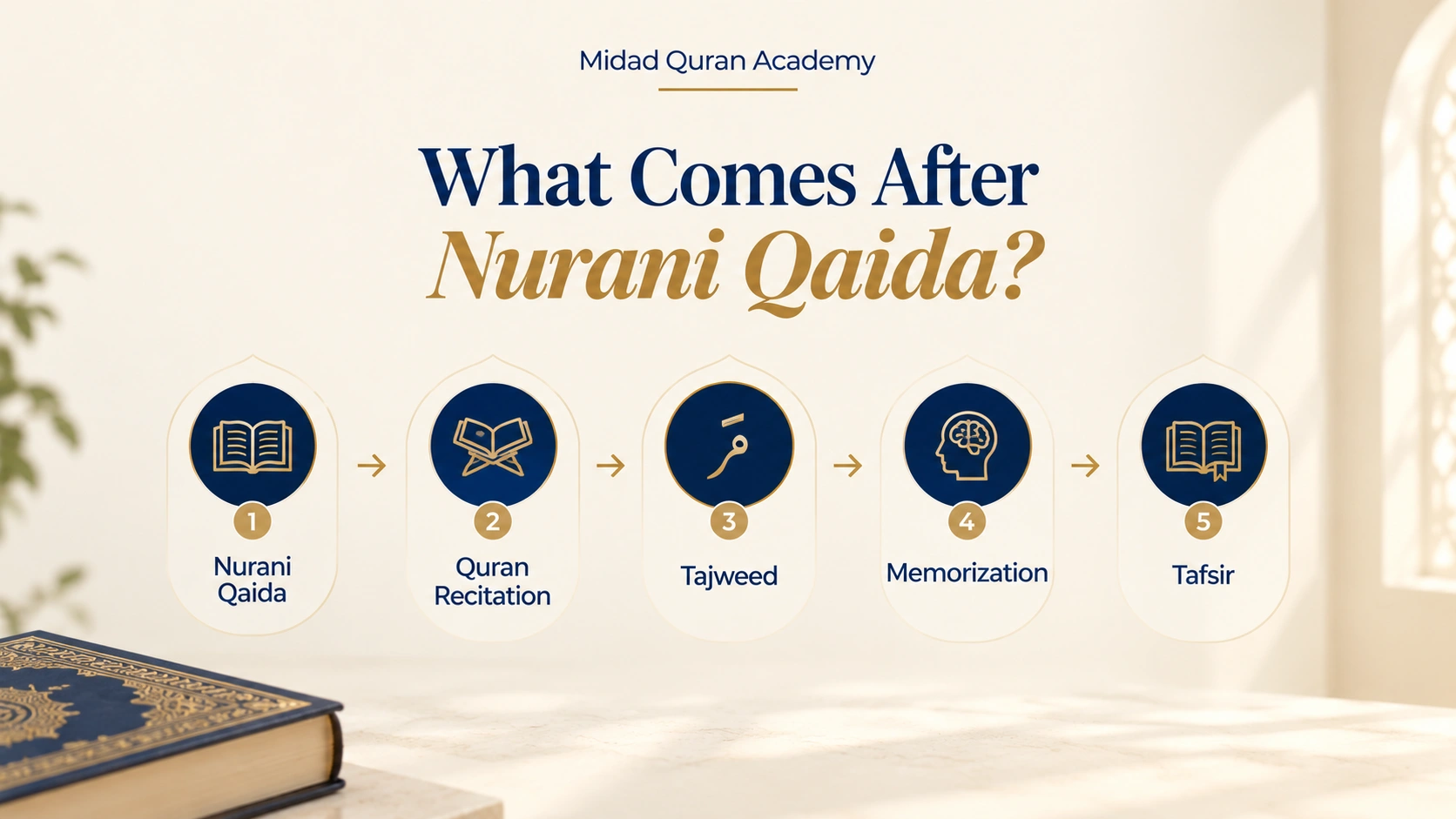
Finishing Noorani Qaida is an encouraging moment. The learner has worked through Arabic letters, reading signs and joined words. Naturally, the next question is: Can they begin reading the Quran now?
For learners aiming to read the Quran independently, the usual next step after Noorani Qaida is guided Quran Reading. But reaching the last page of the Qaida does not, by itself, tell us whether the foundation is secure. What matters is whether the learner can use those skills with unfamiliar written words, rather than depending mainly on examples they already know.
That distinction gives parents and teachers a much clearer way to decide what should happen next.
The next step is to use Qaida skills in the Quran
Noorani Qaida helps beginners understand the building blocks of reading: recognising letters, producing their sounds, following joined forms and applying signs such as short vowels, Sukoon, Shaddah and Madd. Quran Reading brings those pieces together in continuous Quranic text.
It is a change in how the skills are used, not a sudden change from beginner to expert. A learner may handle individual Qaida exercises well but still need time to recognise the same patterns when several appear together in an ayah. They might read slowly, pause to work out a word or ask the teacher for help. That does not mean they have failed.
The question is whether they can begin working through new text with guidance—not whether they can already recite pages fluently without mistakes.
Five things a teacher should check before moving on
Rather than looking only at the lesson number, ask what the learner can do when the order of the examples changes.
1. Can they identify letters outside their memorised order?
A learner should be able to recognise letters when they appear separately and inside simple words. If they can say the alphabet in sequence but repeatedly confuse individual letters when shown at random, more recognition practice may help.
2. Do they notice the reading signs?
Look at what happens when the learner sees Fathah, Kasrah, Dammah, Sukoon, Shaddah or a basic Madd pattern. Are they reading what is actually written, or relying on how they remember an earlier exercise sounded? Occasional hesitation is different from regularly missing the signs.
3. Can they work through joined forms and unfamiliar combinations?
Recognising a letter on its own is one skill; spotting it when its written shape changes in a connected word is another. The learner does not need to read every unfamiliar combination quickly, but should be able to make a genuine attempt rather than waiting for the teacher to say the whole word first.
4. What happens after a correction?
Suppose the learner misses a vowel. When the teacher draws attention to it, can the learner try again and apply the correction? This reveals more than simply counting mistakes. A child who corrects a word after a helpful prompt may be ready for gradual Quran Reading with continued support.
5. Can they try a short new passage without hearing it first?
A familiar Surah may be recited beautifully from memory. Memorisation is valuable in its own right, but it does not show the same skill as reading unfamiliar text from the page. A teacher can choose a short, suitable Quranic passage and observe whether the learner follows its letters and signs.
None of these checks requires perfect performance. Together, they help the teacher see which foundations are reliable and which still need attention.
How Midad checks readiness at the end of Noorani Qaida
At Midad Quran Academy, teachers use the comprehensive exercise at the end of Noorani Qaida to check whether a learner is ready to move into Quran Reading. It brings together the letters, joining patterns and reading signs introduced throughout the book.
The teacher asks the learner to read and combine the letters and signs independently, rather than relying only on repeating the teacher or recalling the page from memory. Earlier Qaida exercises can also be revisited to check a particular weakness.
If the learner can read the final comprehensive exercise independently, the teacher considers them ready to begin Quran Reading. As they move into Quranic text, the teacher continues checking whether the learner recognises the letters and signs and can form and read words correctly.
The exercise is part of Midad's actual teaching process; it is not a promise that every learner must already read longer passages fluently before starting Quran Reading. Teachers still adjust the pace and review earlier skills as needed.
The following observations can help explain why the teacher may recommend different next steps:
| What the teacher notices | Possible next step |
|---|---|
| Letters and signs are generally understood; the learner reads slowly but responds to correction. | Begin short, guided Quran Reading while continuing review. |
| Most examples are recognised, but a few specific signs or joined forms cause repeated mistakes. | Combine introductory Quran Reading with focused Qaida revision, if appropriate. |
| The learner relies heavily on memorised sequences and struggles to identify letters or basic signs independently. | Strengthen those Qaida foundations before increasing the reading demand. |
This is not a rigid scoring system. The goal is to make the next lesson fit the learner.
There is a useful parallel with broader reading education: decoding involves applying letter–sound knowledge to words a reader has not previously seen. Reading Rockets explains this general literacy principle in its guide to decoding. Quranic Arabic has its own pronunciation and recitation requirements, so a Quran teacher still needs to assess those directly.
What might the first Quran Reading lessons look like?
A useful transition starts small. A teacher may select a short passage containing signs and patterns the learner has already studied. The learner reads it aloud; the teacher listens for a few important difficulties, models the correct reading and gives another chance to apply the correction.
At first, the learner may read slowly and need frequent prompts. As familiar patterns become easier to recognise, the teacher can gradually introduce less familiar text or slightly longer passages. The amount of support should depend on what the learner can actually manage.
There is no need to promise that everyone will move forward after a fixed number of weeks. Some learners will benefit from extra Qaida revision alongside Quran Reading, and others may need more time on the basics before beginning continuous text.
For families choosing between the two stages, Midad's Noorani Qaida programme focuses on those foundations, while its Quran Reading classes focus on applying them in guided recitation.
Does Tajweed start only after Noorani Qaida?
No. Correct letter sounds and basic reading rules can be taught while a learner is studying Qaida. The move to Quran Reading does not mean leaving pronunciation behind. It means applying those foundations more consistently within Quranic text.
A learner who reads words independently but struggles with particular pronunciation or recitation rules might also need deeper Practical Tajweed instruction. Another learner may still need help with letters and reading signs before complex rules become useful. A teacher can decide which support should come first; there is no single rigid pathway for everyone.
What can parents do without turning reading into a test?
Ask the teacher one simple question: “Can my child read a short unfamiliar example, or mainly the lines they have already practised?” The answer is more useful than asking only how many pages are finished.
At home, you can listen to the specific practice the teacher has assigned, notice whether your child attempts the written words and encourage careful effort. You do not need to test random Quran passages or correct sounds you are unsure about. If something seems difficult, note it and ask the teacher.
Praise progress in a specific way: “You noticed the vowel this time,” or “You tried that word again after the correction.” This keeps attention on real learning rather than rushing towards a finishing date.
Finishing Qaida is a milestone; reading independently is the goal
For learners whose goal is to read independently, the next stage is guided Quran Reading, followed by greater accuracy, confidence and fluency. The right time to begin is when their current skills are strong enough to use in new text with appropriate support.
So before celebrating the last Qaida page as the end of beginner learning, ask to see what the learner can read without memorising the answer first. That small check can reveal the next useful step.
At Midad Quran Academy's three free trial classes, the teacher can observe the learner's starting level, identify the skills that need more work and help the family decide whether Noorani Qaida or Quran Reading is the better fit. There is no payment before the three trials.
