

Online Tajweed Classes for Clearer, More Accurate Quran Recitation. Apply Tajweed While You Recite.
Learn Quran online with Tajweed through live one-to-one classes for children, teenagers, and adults who can already read the Quran. We explain each rule clearly, show how it affects the recitation, correct mistakes as they happen, and help you apply Tajweed during real Quran reading. The focus is not simply knowing rule names. It is recognising and using them correctly while you recite. Learn each Tajweed rule clearly, apply it while reading the Quran, and receive live correction until the recitation becomes more accurate.

Learn each Tajweed rule clearly, apply it while reading the Quran, and receive live correction until the recitation becomes more accurate.
3 Free Trial ClassesLearn the Rule, Hear the Difference, Then Apply It in Recitation.Learn the Rule. Use It While Reading.
Tajweed is difficult to improve through theory alone. In each one-to-one lesson, the teacher explains the relevant rule, demonstrates how it affects the sound, listens to the learner apply it, corrects mistakes immediately, and returns to weak areas when they appear again.The teacher explains, demonstrates, listens, corrects, and helps you practise the rule inside real Quran recitation.

A rule is learned properly when the learner can recognise and apply it while reciting.The rule matters when you can use it while reciting.
Understand the RuleUNDERSTAND
Learn what the Tajweed rule means, where it appears, and what it changes in the recitation.Know what the rule means and where it applies.
Hear the DifferenceHEAR
The teacher demonstrates the sound, length, articulation, pause, or pronunciation so the learner can hear what needs to change.Listen to the correct sound, length, or pronunciation.
Apply It While ReadingAPPLY
The learner uses the rule directly in Quran recitation instead of leaving it as a separate theory exercise.Use the rule while reading the Quran.
Correct and RepeatREPEAT
Mistakes are corrected as they happen, then the learner repeats the reading with guidance until the correction becomes clearer.Practise the correction with live teacher guidance.
Review When It ReturnsREVIEW
If the same Tajweed mistake appears again in later recitation, it becomes part of the lesson again instead of being ignored.Return to repeated mistakes when they appear again.
Explain it. Hear it. Apply it. Correct it. Practise it again.Learn → Apply → Correct → Repeat
Learn the Rule. Use It While Reading.
The teacher explains, demonstrates, listens, corrects, and helps you practise the rule inside real Quran recitation.
Live Tajweed Correction With Progress You Can See.
Tajweed progress should appear in the learner’s actual recitation. We correct mistakes while the Quran is being read, record recurring weak areas, and keep the next priority visible.
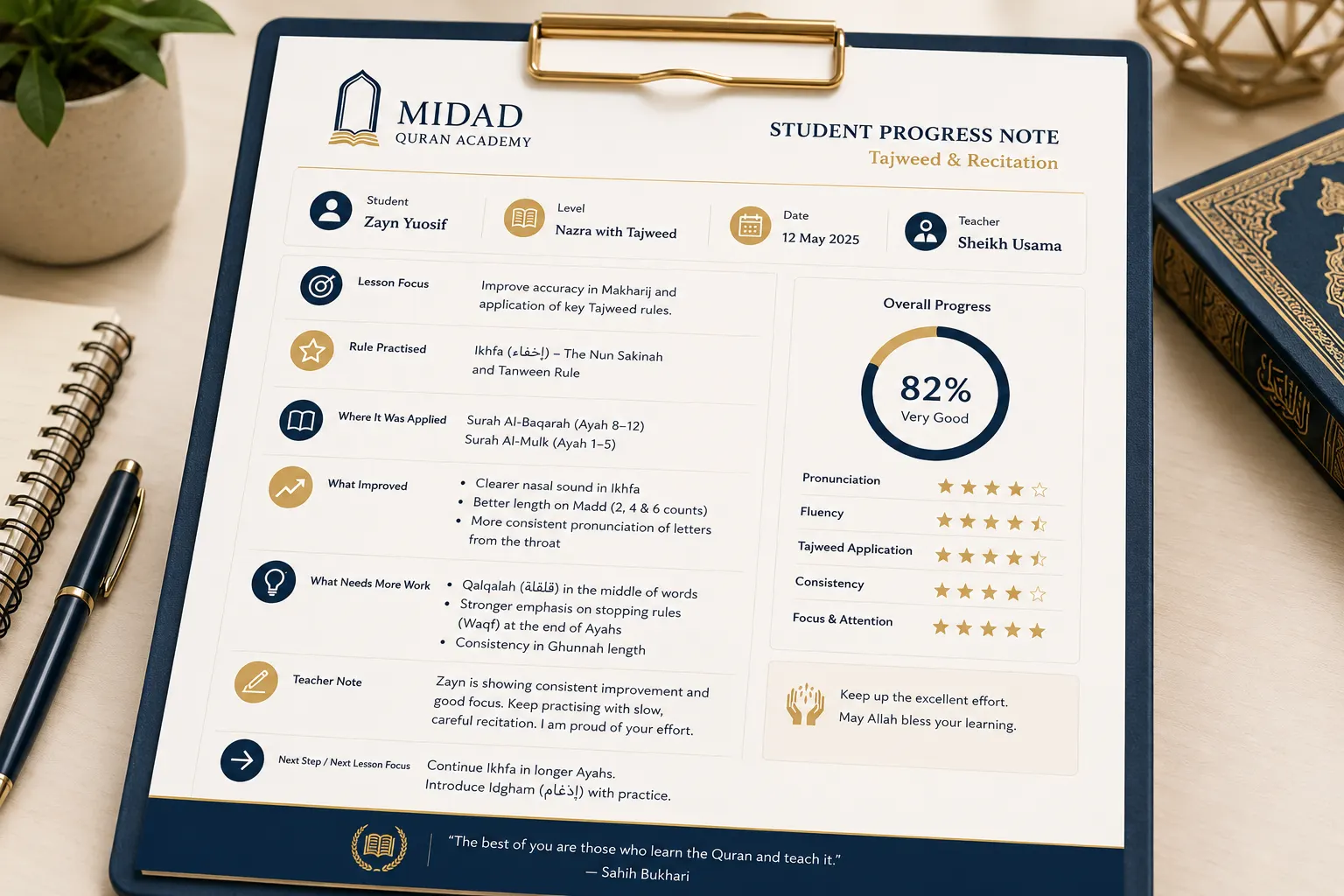
What was corrected. Where it was applied. What still needs attention.
Makharij & Letter Sounds
Unclear articulation points, similar letter sounds, and pronunciation that becomes too heavy, too light, or otherwise inaccurate.
We note which sounds were practised, which became clearer during recitation, and which still need focused correction.
Tajweed Rules in Recitation
Rules the learner understands in theory but misses, confuses, or applies inconsistently while reading the Quran.
We record where the rule was applied correctly and where teacher prompting is still needed.
Madd, Pace & Recitation Control
Rushed reading, inconsistent lengthening, and loss of control when several rules appear within the same passage.
Progress becomes visible when the learner maintains more accurate timing and a steadier recitation with less prompting.
Waqf, Pauses & Flow
Weak stopping points, awkward pauses, or reading that continues without enough attention to where and how the recitation should stop.
Repeated stopping and flow problems stay in the progress record until the learner applies them more consistently.
Recurring Mistakes & Next Priority
Mistakes that continue returning after earlier explanation and practice.
The learner moves forward when improvement begins appearing consistently in recitation, not simply because the rule has already been explained once.
Live Tajweed Correction With Progress You Can See.
Tajweed progress should appear in the learner’s actual recitation. We keep recurring weak areas visible, show what is becoming stronger, and make the next priority clear.
Tajweed Progress Snapshot
Rule application is becoming more consistent. Keep Ghunnah and stopping points as the next focused practice area.
What Was Corrected
Important pronunciation and Tajweed mistakes stay visible instead of disappearing after class.
What Improved
See where recitation is becoming clearer, steadier, and more accurate.
What Comes Next
The next lesson priority remains clear, so weak areas are revisited instead of forgotten.
Correct the Mistake. Track What Improves.
See which Tajweed areas were corrected, what became stronger, and what still needs practice.
Tajweed Progress Snapshot
Recitation is becoming more controlled. Rule application is stronger, while repeated pronunciation and pause mistakes still need guided practice.
Strengthen Ghunnah and stopping points.
These areas return in the next lessons until the improvement becomes more consistent.

Build a Stronger Base for What Comes Next.