

Your child has memorised a few short Surahs, and hearing them recite from memory makes you happy. Naturally, you begin wondering whether it's time for them to start Hifz and perhaps eventually memorise the entire Quran.
But how can you know whether they're ready?
A child is ready to be considered for a structured Hifz programme when they can read Quranic text accurately enough to prepare their lessons, show an ability to retain and revise memorisation, and follow a realistic learning routine with appropriate support. A qualified teacher should assess these skills before recommending the next step.
There is no single age when every child becomes ready. And memorising a few Surahs, while an encouraging achievement, does not tell us everything about their readiness for longer-term Quran memorisation.
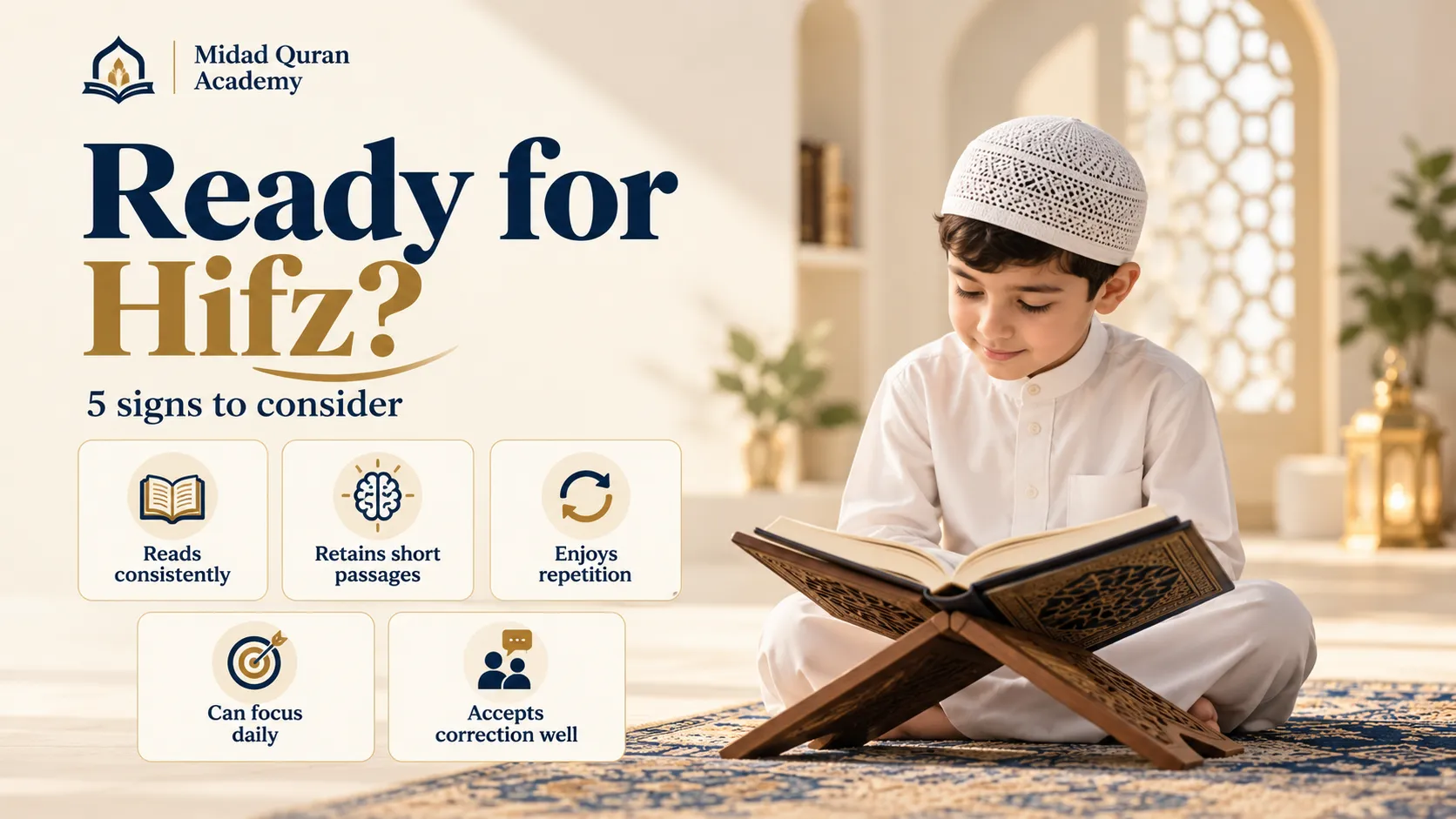
Here are five things worth considering before you begin.
1. Can Your Child Read the Quran Accurately?
This is the first thing we would look at.
A child might recite Surah Al-Fatihah or several short Surahs confidently because they have heard and repeated them many times. But what happens when they open the Quran and try to read a passage they haven't memorised?
Can they recognise the Arabic letters? Do they understand the reading signs? Can they join words and apply basic pronunciation corrections?
These are important foundations for structured Hifz.
As memorisation progresses, learners need to prepare new passages and revisit older ones. A child who struggles significantly with reading may find it difficult to practise independently between lessons.
There is also a risk of repeatedly memorising a word with incorrect pronunciation if the child cannot recognise or check what is written.
At Midad Quran Academy, our structured Hifz programme is intended for learners who can already read Quranic text with suitable accuracy and fluency.
If that foundation is not secure, we recommend strengthening it through Noorani Qaida or guided Quran Reading before beginning formal Hifz.
This doesn't mean a younger child cannot enjoy listening to the Quran or memorising familiar short Surahs through repetition. Those activities can be valuable.
It means that participating in a structured memorisation programme requires a different level of reading independence.
2. Can Your Child Remember a Passage After Some Time Has Passed?
Suppose your child learns a short passage today and recites it correctly after practising several times.
That's encouraging.
But can they still recite it tomorrow? What about after a few days, without immediately hearing it again?
There is a difference between repeating something just after learning it and being able to recall it later.
Before starting a structured Hifz programme, a teacher can listen to previously memorised passages and observe how reliably the child remembers them.
Some children recall familiar Surahs independently. Others may need a reminder at the beginning or repeated help to continue.
Needing help does not mean a child cannot learn Hifz. It gives the teacher information about their current memorisation skills and the amount of support they may need.
Research on learning and memory also supports the value of checking recall over time.
A major review by Dunlosky and colleagues, published in Psychological Science in the Public Interest, identified practice testing and distributed practice as useful learning techniques across general educational contexts.
These findings are not a Quran-specific readiness test, but they help explain why recalling learned material after a gap provides useful information beyond repeating it immediately.
For parents, the question is simple:
Can my child remember what they have learned when the lesson is no longer fresh?
The teacher can use that answer to recommend an appropriate starting point.
3. Is Your Child Willing to Revise, Not Just Memorise Something New?
Some children enjoy memorising a new Surah.
They feel excited when they complete it and want to move straight to the next one.
But Hifz involves returning to earlier memorisation again and again.
As the learner memorises more Quran, they also need to maintain what they have already learned.
This means revision cannot be treated as an occasional activity reserved for when someone forgets.
Consider a child who likes learning new passages but becomes frustrated whenever the teacher asks them to revisit an older one.
That doesn't automatically mean they're not ready for Hifz.
It may mean they need help understanding why revision matters and gradually becoming comfortable with it.
A parent can observe whether the child is willing to return to familiar Surahs, respond to corrections and practise something that isn't completely new.
Teachers can develop these habits over time, so we should not expect perfect self-discipline from a beginner.
The UK's Education Endowment Foundation explains that self-regulation involves helping learners plan, monitor and reflect on their learning. These abilities can be explicitly taught and supported rather than assumed to be present from the beginning.
That principle is relevant to Hifz: a child may need guidance to understand their revision responsibilities.
Readiness is not about enjoying every repetition. It is about being able to begin a sustainable learning routine with support.
4. Does Your Family Have Time for Regular Hifz Practice?
This is sometimes overlooked.
A child may be interested in Hifz, and their reading may be strong enough, but the family timetable could already be full.
School, homework, sports, family activities and rest all need consideration.
Hifz does not end when the online class finishes.
A learner also needs suitable time between lessons to prepare new memorisation and revisit previous portions.
At Midad Quran Academy, the regular Hifz programme includes five one-to-one classes each week, lasting 45 minutes per session. Lessons bring together new memorisation, recent revision, older revision and correction.
The teacher decides how much material is appropriate for the learner, while the family helps make the assigned practice possible.
Before beginning, ask yourself:
- Is there a realistic time when my child can prepare and revise?
- Can we maintain the routine alongside school and other responsibilities?
- Who will help my child organise their practice when needed?
- Can we communicate with the teacher if the workload becomes difficult?
The goal isn't to fill every available minute with memorisation.
It's to find a routine the child can maintain without unnecessary pressure.
If the family cannot currently support regular revision, that is something worth discussing before enrolling. It may be sensible to establish a manageable Quran reading and revision habit first.
5. Does Your Child Feel Comfortable Beginning the Hifz Journey?
Parents often have meaningful hopes for their children's Quran education.
Perhaps you would love your child to become a Hafiz or Hafiza. It's understandable to feel excited about that possibility.
But how does your child feel about it?
Do they show interest in memorising more Quran? Are they comfortable learning with a teacher? How do they respond when a passage needs correction or additional practice?
A child does not need to understand the full commitment involved in memorising 30 Juz before starting.
Young learners naturally depend on parents and teachers to provide direction and structure.
Still, their experience matters.
If a child feels constantly overwhelmed, resists every lesson or becomes distressed by the learning arrangement, it is worth examining whether the expectations, workload or teaching approach need changing.
That does not necessarily mean abandoning Hifz.
Sometimes a smaller initial goal, clearer explanation or different learning arrangement may be more appropriate.
A positive relationship with Quran learning is worth protecting.
The aim should be to help the child engage with memorisation meaningfully, not simply push them towards a target they cannot yet manage.
A Simple Hifz Readiness Checklist for Parents
Before committing to a regular Hifz programme, consider these five questions.
| Readiness question | What to look for |
|---|---|
| Reading: Can my child read Quranic text with suitable accuracy? | Recognises letters and signs, reads connected words, and responds to pronunciation correction |
| Recall: Can my child remember previously learned Surahs? | Can attempt familiar passages from memory after time has passed |
| Revision: Can my child begin following a revision routine? | Willing to revisit older passages with appropriate encouragement |
| Home routine: Can we support regular preparation? | A realistic practice time alongside school, rest and family life |
| Participation: Is the learning experience suitable for my child? | Can participate, communicate with the teacher and receive correction with support |
This checklist is a practical conversation guide, not a standardised test or a fixed admissions score.
A child does not have to demonstrate perfect memory, concentration or independence in every area.
The purpose is to identify strengths, recognise difficulties and help a qualified teacher decide what should come next.
Should Your Child Begin Full Hifz or Memorise Selected Surahs?
There is another decision that parents sometimes overlook.
Starting Quran memorisation does not necessarily mean committing immediately to memorising all 30 Juz.
Some families want their children to memorise the entire Quran.
Others may have a more focused goal, such as memorising selected Surahs or a particular Juz.
Both are meaningful learning goals, but they require different planning.
At Midad Quran Academy, our Hifz course supports both full and partial memorisation pathways.
For learners pursuing full Hifz, our confirmed teaching sequence begins with Juz 30 before moving to Juz 1 and continuing through the remaining Juz.
For partial Hifz, the teacher considers the learner's chosen Surahs or Juz and builds an appropriate memorisation and revision plan.
The suitability assessment still matters in either case.
If the child is not yet able to read Quranic text accurately enough for structured memorisation, strengthening their reading foundation may be the better starting point.
Parents should feel comfortable explaining their actual goals rather than choosing full Hifz simply because it appears to be the expected option.
What If Your Child Isn't Ready Yet?
Imagine a child who enjoys reciting several short Surahs but still struggles to recognise unfamiliar Arabic words.
They may have good memorisation potential, but the immediate learning priority might be Quran Reading.
Another child may read fluently and remember passages well but have very little time for revision during the school week.
For that child, the family and teacher may need to work on a realistic routine before increasing memorisation.
These are illustrative situations, not accounts of particular Midad students.
The important point is that readiness is not an all-or-nothing judgement about a child's ability.
Sometimes the next step is to improve reading fluency. Sometimes it is to strengthen pronunciation, establish regular practice or begin with a smaller memorisation goal.
Taking time to prepare does not mean the child has fallen behind.
It means the learning plan is being built around what they actually need.
How Does Midad Check Hifz Readiness?
At Midad Quran Academy, we begin by understanding the learner's current position.
During the three free trial classes, the teacher can assess reading and pronunciation, listen to previously memorised passages, discuss learning goals and identify what needs attention.
For a child considering Hifz, the assessment considers whether they can read Quranic text with suitable fluency, how reliably they recall memorised material and whether a realistic revision routine can be established.
The teacher then recommends a suitable direction.
That might mean beginning a structured Hifz programme, continuing existing memorisation or strengthening foundational Quran Reading first.
We do not promise that every learner will complete a particular number of Surahs or Juz within a fixed period.
The amount of new memorisation and revision is adjusted to the learner's actual ability and progress.
Parents can explore our one-to-one Hifz programme to understand the course, class structure and approach to revision.
Readiness Is More Important Than Rushing to Begin
It is encouraging when a child shows an interest in memorising the Quran.
But before beginning a structured Hifz programme, it is worth understanding whether their reading foundation is secure, whether they can begin retaining and revising memorised passages, and whether the family can support a suitable routine.
There is no need to choose a starting age or memorisation target simply because another child has already begun.
The right time to start Hifz is when the learner has a suitable foundation and a realistic plan for memorisation and revision.
And if you're unsure, a teacher's assessment can help make that decision clearer.
Midad Quran Academy offers three free trial classes before payment, giving parents an opportunity to understand their child's readiness and discuss the most appropriate next step.
