

Your child remembered a Surah confidently a few weeks ago. But today, when the teacher asks them to recite it again, they hesitate, forget the next ayah or need help to continue.
For parents, this can be worrying. Was all that memorisation lost? Should we start again? Or should the child continue with new lessons?
When previously memorised Quran becomes weak, the first step is to identify which passages need attention, strengthen them through regular revision, and adjust new memorisation until the older lessons become more secure.
A Hifz routine using Sabak, Sabqi and Manzil can help organise that process. The important thing is not to rush through more pages while earlier memorisation continues to weaken.
First, Find Out What the Learner Has Actually Forgotten
Not every hesitation means the same thing.
A learner might remember a Surah correctly when reciting from its beginning but struggle when asked to continue from a later ayah. Another may remember the words but confuse passages with similar wording. Someone else may need frequent prompts because the passage was never memorised securely.
These situations need different kinds of practice.
Before giving the learner more material to memorise, a teacher can listen to a few previously learned passages and identify where the difficulty begins.
For example, the teacher might ask the learner to:
- Recite a recently memorised passage without looking at the Mushaf.
- Recite a portion learned several weeks or months earlier.
- Continue from a selected point within a familiar passage.
- Try again after receiving correction.
The purpose isn't to catch the learner making mistakes. It is to understand which parts are still secure and which need rebuilding.
Being able to read a passage from the Mushaf is not the same as being able to recite it from memory. Both are valuable skills, but Hifz requires the second.
At Midad Quran Academy, assessing memorisation from memory is part of the Hifz teaching process. When older portions become weak, teachers may reduce or temporarily pause new lessons while those sections are strengthened.
How Sabak, Sabqi and Manzil Work Together
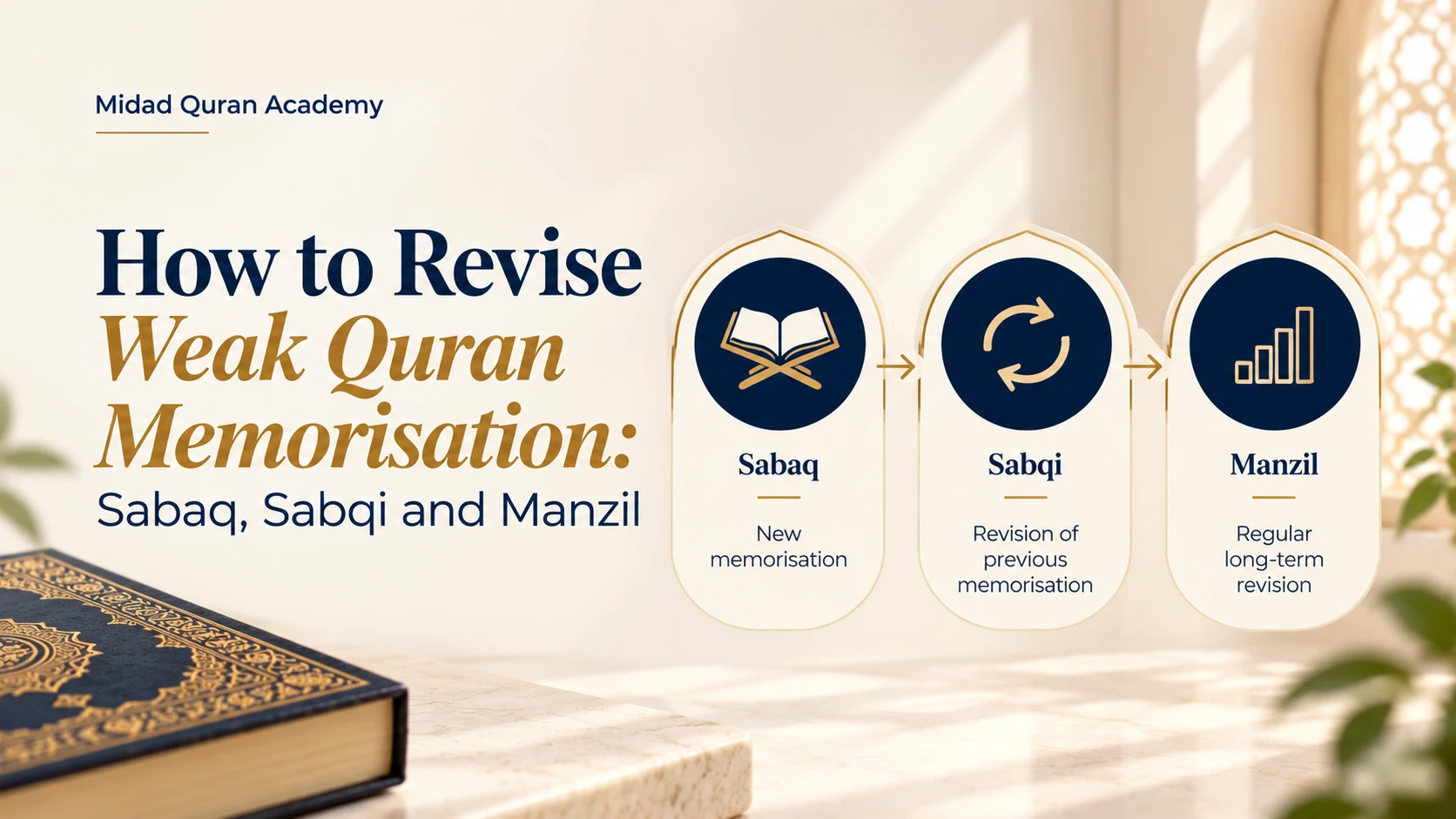
Many Quran memorisation programmes use three terms to organise learning and revision.
| Part of Hifz | What it means | Why it matters |
|---|---|---|
| Sabak (سبق) | The new passage currently being memorised | Adds new material accurately |
| Sabqi (سبقی) | Recently memorised passages that need continued revision | Strengthens newer memorisation |
| Manzil (منزل) | Older memorised Surahs or Juz reviewed regularly | Helps maintain earlier learning |
The exact amount included under each heading can differ between teachers and programmes.
Imagine a learner who has memorised several Surahs.
Their new assignment belongs to Sabak. The lessons memorised recently need Sabqi revision. Surahs learned much earlier belong to Manzil.
Now imagine that the learner keeps completing new Sabak but rarely revises Manzil.
Over time, they may become increasingly confident with the latest lesson while struggling to remember what they learned months ago.
That is why all three parts must receive attention.
How Midad Uses These Parts in Hifz Classes
Midad Quran Academy's Hifz teaching framework includes new memorisation, recall of the five most recent lessons, accumulated recent revision and older memorisation.
During a 45-minute one-to-one Hifz class, the teacher listens, checks retention and corrects recitation. The amount of time given to each part depends on the learner's needs.
The recent-five review helps teachers revisit lessons that have only just been memorised. Sabqi builds continued recall across the recent portion, while Manzil brings older memorisation back into regular practice.
These are not separate stages that a learner completes once and leaves behind. They remain connected throughout the memorisation journey.
And when older lessons become weak, the balance can change.
A Practical Way to Rebuild Weak Memorisation
Suppose a learner has memorised several Surahs but can no longer recite two of them reliably.
The following recovery approach can help a teacher decide how to strengthen those passages without overwhelming the learner.
Step 1: Identify the Weak Sections
Start with the Surahs or passages the learner already knows.
Ask them to recite from memory while the teacher listens carefully.
Notice where they hesitate, which words they confuse and whether they can continue without repeated prompts.
There may be no need to relearn every passage. Some sections might already be secure, while others require focused work.
The first goal is to understand the difficulty accurately.
Step 2: Reduce or Pause New Sabak When Necessary
If older memorisation is seriously weakening, adding more new material may make the revision workload harder to manage.
In that situation, the teacher may temporarily reduce new Sabak or pause it altogether.
This is not a punishment, and it does not mean the learner is incapable of Hifz.
It simply gives them time to strengthen what they have already learned.
For one learner, a smaller new assignment might be sufficient. Another may need several lessons devoted mainly to revision.
The decision should be based on how well the learner recalls the existing material, rather than on a fixed number of pages or days.
Step 3: Rebuild Each Passage in Manageable Parts
Once the teacher identifies a weak passage, work through the difficult sections carefully.
First, check the words and pronunciation against the Mushaf with the teacher's guidance. Then divide the passage into smaller sections if necessary.
After practising a section, close the Mushaf and try reciting it from memory.
If an error occurs, return to the correct wording, practise it carefully and try recalling the passage again.
As the smaller sections become more reliable, connect them and practise reciting the passage continuously.
A learner who keeps confusing two similar ayahs may need extra attention to the words that distinguish them.
The aim is not merely to repeat the passage many times. It is to reach the point where the learner can recall it correctly without constantly looking at the text.
Step 4: Return to the Same Passage Over Several Days
A passage that sounds accurate immediately after repeated practice may still be difficult to remember later.
This is why a recovery plan needs follow-up.
The learner should revisit the passage after some time has passed, then practise recalling it again in later sessions.
There is useful support for this approach in general learning research. A major review by Dunlosky and colleagues found strong educational value in practice testing and distributing study over time.
These findings are not a Quran-specific Hifz trial, but they help explain why recalling material after a gap can be more informative than simply reading the same passage repeatedly.
The teacher can use these repeated checks to decide whether the memorisation is becoming secure enough to resume normal progress.
An Example of a Five-Class Hifz Recovery Plan
Let's imagine a learner who can recite recent lessons reasonably well but struggles with two older Surahs.
This is an illustrative teaching plan, not a real student case or a fixed Midad timetable.
| Class | Main focus | What the teacher checks |
|---|---|---|
| 1 | Listen to the weak Surahs and identify difficult passages | Which sections can be recalled independently? |
| 2 | Rebuild the first weak passage in smaller parts | Can the learner recite it without looking? |
| 3 | Revisit the first passage and work on the second | Has the earlier correction been retained? |
| 4 | Connect sections and revise other assigned material | Can the learner continue with fewer prompts? |
| 5 | Recheck both passages after time has passed | Is further recovery needed before increasing new Sabak? |
Depending on the learner's starting point, some work may continue across several weeks. The teacher may also include appropriate recent revision and other secure older passages throughout the recovery period.
There is no guarantee that every learner will recover a weak passage within five classes.
The value of the plan is its direction: identify the difficulty, repair it, return to it and check whether the improvement lasts.
How Do You Know When to Start New Memorisation Again?
This is an important decision.
A learner may be eager to return to new Surahs after spending time revising older ones. But moving forward too soon can recreate the same problem.
Before increasing new Sabak, the teacher should look for meaningful signs of retention.
Can the learner recite the repaired passage without looking at the Mushaf? Can they continue without constant prompting? Do previously corrected mistakes remain corrected when the passage is revisited later?
A learner does not need to become completely free from every occasional hesitation. However, their existing memorisation should be sufficiently secure for the teacher to judge that more new work is manageable.
At Midad, the Hifz plan can be adjusted when retention becomes weak, and new memorisation resumes according to the teacher's assessment.
The goal is progress that can be maintained.
What Can Parents Do When Their Child Keeps Forgetting?
It can be discouraging to hear a child struggle with a Surah they previously recited confidently.
But frustration rarely tells us what needs correcting.
A more useful starting point is to ask the teacher:
“Which part of my child's memorisation is weak, and what exactly should we revise this week?”
You do not need to design a new Hifz programme yourself.
Instead, help your child follow the teacher's assigned revision, protect a manageable practice time and make sure older Surahs are not forgotten while attention stays on the newest lesson.
If you are comfortable listening to the recitation, allow your child to complete the assigned section without frequent interruption. Record any difficulty and ask the teacher when you are unsure about the correct wording or pronunciation.
Try to recognise specific improvements.
Perhaps your child needed several prompts yesterday but managed the same passage more independently today. That is useful progress, even if they have not added any new ayahs.
You can also tell the teacher when schoolwork, tiredness, illness or family commitments are making practice difficult.
Sometimes the right solution is a smaller, more sustainable assignment.
What If Weak Memorisation Keeps Returning?
If the same passages become weak repeatedly, the teacher may need to look beyond that week's revision.
Is the learner receiving enough regular practice? Are the older Surahs included in a continuing Manzil rotation? Is the new Sabak taking too much of the available time?
It is also worth checking whether pronunciation or reading difficulties are affecting memorisation, or whether the learner can recite a passage only after hearing its opening words.
A reliable Hifz programme should be able to adapt when these problems appear.
Midad's memorisation framework includes continuing review of both recent and older work, alongside teacher assessments of retention and recitation quality.
The purpose is to understand a learner's actual progress—not simply record how many additional pages have been memorised.
Strong Hifz Means Remembering What You Have Learned
When memorisation becomes weak, the answer is not always to memorise more.
Often, the more useful step is to return to what has already been learned, identify the difficult portions and give them the revision they need.
Sabak, Sabqi and Manzil provide a way to organise that responsibility: new memorisation, recent revision and older revision, working together.
For parents and adult learners, the most important question is not only, “How much Quran have I memorised?”
It is also, “How much can I still recite accurately from memory?”
If you or your child need support rebuilding weak memorisation or organising a more sustainable revision routine, you can explore Midad Quran Academy's one-to-one Hifz classes.
Our three free trial classes allow the teacher to understand the learner's current level before recommending the next step.
