

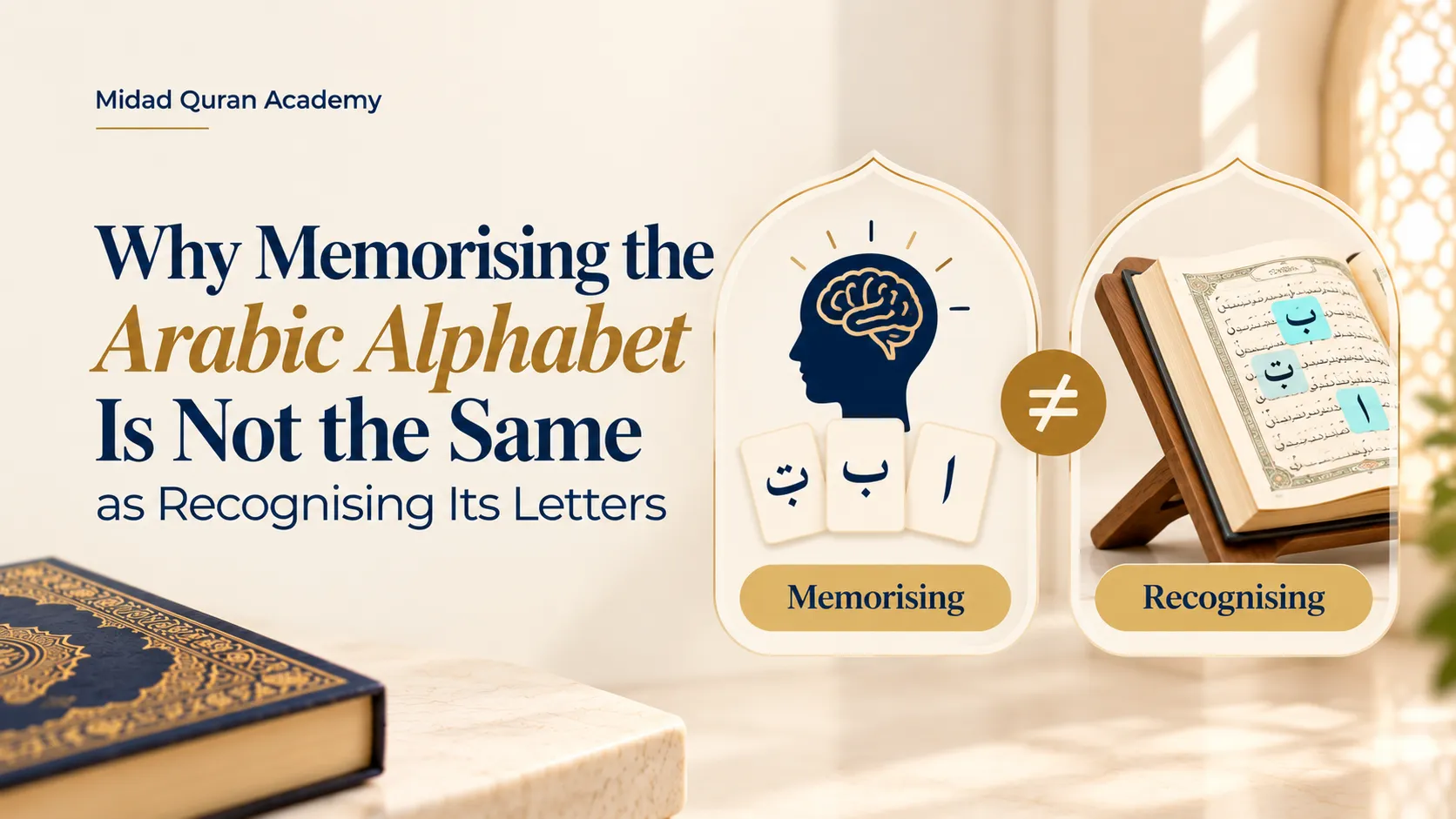
Your child can recite the Arabic alphabet from beginning to end. They have completed several Qaida lessons, and everything seems to be going well.
But what happens when you point to one letter in the middle of the page and ask them to identify it?
Suddenly, they hesitate.
Memorising the Arabic alphabet and recognising Arabic letters are two different skills. A learner may remember the order of letters or the sounds of familiar lessons without being able to identify each letter independently.
To begin reading Arabic confidently, a learner needs more than memorised sequences. They need to recognise individual letters, connect them with their sounds and gradually identify those same letters in different written forms.
This distinction is particularly important when children are beginning to learn Quran reading.
A Quran Learning Experience That Raised an Important Question
At Midad Quran Academy, we received a concern from a mother in the United Kingdom whose son had been studying the Quran for six years.
Despite those years of lessons, she was worried that he was still struggling to read independently.
She believed he had become familiar with memorising the lessons rather than understanding how to recognise and read individual Arabic letters.
Her concern wasn't simply that he had forgotten a particular lesson. It was that the reading foundation she expected him to develop might not have been secure.
We cannot establish everything that happened during those previous years from one parent's account. But her experience raises an important question for anyone teaching Quran reading:
Can the learner recognise the letters when they are shown in a different order, or do they mainly remember how the familiar lesson sounds?
This is a distinction worth checking early, not after years of study.
The point is not to blame a child or assume a previous teacher did nothing useful. It is to understand what the learner has actually learned and what still needs attention.
Why Can a Child Remember the Alphabet but Struggle to Recognise Letters?
Think about how a child might learn the alphabet.
The teacher points to each letter and reads it aloud. The child repeats. Over several lessons, the sequence becomes familiar.
Eventually, the child may be able to recite the complete sequence from memory.
That is a useful beginning. It introduces the letters and gives the learner familiarity with their names and sounds.
But it does not necessarily show that the child can identify each written letter separately.
Consider the difference between these two tasks:
Task A: Recite the Arabic alphabet in the order you learned it.
Task B: Look at the letter ث on its own and identify it, without hearing the letters that usually come before it.
The first task can rely on remembering a familiar sequence. The second requires recognition of a particular written symbol.
A learner might manage one task while finding the other difficult.
This distinction is consistent with general literacy research. The Texas Education Agency's explanation of the alphabetic principle, published by Reading Rockets, distinguishes learning letter names from recognising written forms and connecting letters with sounds.
That research concerns general early reading instruction, not a specific Quran-teaching programme. Nevertheless, the distinction between recalling a sequence and identifying print is relevant when assessing beginner Arabic reading.
Why Arabic Letter Recognition Needs Careful Practice
Arabic introduces some particular visual challenges.
Several Arabic letters share a similar basic shape. The dots above or below them distinguish one letter from another.
Look at these examples:
| Letter | What distinguishes it? |
|---|---|
| ب | One dot below |
| ت | Two dots above |
| ث | Three dots above |
| ج | One dot below |
| ح | No dot |
| خ | One dot above |
A child who focuses mainly on the general shape may confuse letters that differ by their dots.
And there is another consideration.
Arabic letters can look different depending on where they appear in a word. A letter shown on its own may take a connected form when written at the beginning, middle or end of a word.
For example, the letter ب appears in different written forms within connected Arabic text.
Recognising the isolated letter is therefore an important starting point, but it is not the complete reading skill.
Research published in Frontiers in Psychology, Learning to Spell in Arabic: The Impact of Script-Specific Visual-Orthographic Features, explains how visual similarity, letter position and joining are important features of Arabic writing.
The study is about Arabic literacy, not an experiment on Midad's students. It helps explain why paying attention to the exact written shape matters.
A Simple Way to Check Whether a Child Recognises Arabic Letters
A teacher does not need to turn every lesson into an examination.
A short, calm activity can reveal whether the learner is relying on a familiar sequence or recognising individual letters.
Step 1: Choose Letters the Child Has Already Studied
Begin with a small selection of familiar letters.
For example:
ب — ت — ث — ج — ح — خ
These letters are useful because several share similar shapes.
The teacher can show them individually and ask the learner to identify each one.
There is no need to introduce unfamiliar letters during this activity. The purpose is to check previously taught recognition.
Step 2: Change the Order
Next, present the same letters in a different sequence:
خ — ب — ح — ث — ج — ت
Ask the learner to identify them again.
If they recognised a letter correctly in the familiar sequence but repeatedly struggle when its position changes, the teacher has learned something useful.
The child may need more practice identifying the letter independently.
This is not proof of a particular learning condition, nor does one mistake establish that the child has been memorising without understanding. The teacher should look for a repeated pattern.
Step 3: Check the Letters in Their Joined Forms
When isolated letter recognition becomes secure, the teacher can introduce previously taught joined forms.
The learner should gradually recognise that the same letter may look different depending on how it connects to neighbouring letters.
The teacher can begin with examples from the learner's Qaida rather than introducing complicated words too early.
Step 4: Add Reading Signs When the Learner Is Ready
Once the learner recognises the letters, the teacher can check whether they identify the signs already studied, such as Fathah, Kasrah and Dammah.
The next challenge is applying those signs while reading letters and simple combinations.
A child who recognises the letters but struggles with Harakat needs different practice from a child who cannot yet distinguish the letter shapes.
The purpose is to identify the specific difficulty so that the next lesson addresses it.
This four-step activity is an illustrative teacher-guided check, not a formally standardised Midad assessment.
How Noorani Qaida Can Support Independent Letter Recognition
One reason Midad Quran Academy prefers Noorani Qaida is its structured progression from individual letters to joined forms and reading signs.
In the coloured Noorani Qaida used by Midad, learners encounter individual Arabic letters near the beginning of the book. Later exercises bring in letter combinations, connected forms and the signs needed for reading.
That sequence creates opportunities for teachers to revisit earlier material as new skills are introduced.
For instance, a child may recognise ب correctly when studying individual letters.
Later, when the letter appears in a joined form, the teacher can check whether the child understands that it is still the same underlying letter.
When vowel signs are introduced, the teacher can observe whether the learner recognises both the letter and the sign rather than repeating the entire example from memory.
But the book alone does not guarantee that these skills have been mastered.
What matters is how the teacher uses the exercises to check understanding.
At Midad, teachers assess progress through the Qaida exercises, including a comprehensive final exercise that brings together previously learned skills.
The learner is expected to read that final exercise independently before moving to Quran Reading. Teachers may also return to earlier exercises when particular foundations need checking.
This provides a more useful indication of readiness than simply recording that every page has been covered.
What Should a Teacher Do When a Learner Is Memorising Instead of Recognising?
If a learner struggles to identify letters independently, repeating the complete alphabet from beginning to end may not address the difficulty.
A better response is to return to the specific letters causing confusion.
Suppose a learner repeatedly mixes up ب, ت and ث.
The teacher might begin by showing the three letters separately and drawing attention to the position and number of dots.
Next, the learner can identify each letter in a changing order.
The teacher then listens to the sounds and corrects pronunciation where necessary.
Once the learner becomes more reliable with those isolated letters, the teacher can revisit them in simple joined forms.
This is a focused approach. Instead of requiring the learner to repeat a whole page, the teacher works directly on the skill that needs attention.
Some children may need several opportunities to practise the same distinctions. Others may recognise isolated letters quickly but need additional support with joined forms.
Neither situation requires the teacher to rush.
The key is to check whether the learner can apply what has been taught, not merely repeat an exercise successfully immediately after hearing it.
How Can Parents Recognise Meaningful Progress?
Parents are not expected to conduct professional Arabic reading assessments.
But they can ask helpful questions about their child's learning.
Rather than asking only, "Which Qaida page did my child finish?", try asking:
"Can my child recognise the letters from that lesson when they appear in a different order?"
You can also ask whether your child recognises the letters inside simple combinations and whether earlier difficulties are still being reviewed.
The teacher should be able to explain what the learner can currently do and what needs further practice.
If your child struggles, there is no need to make them repeat the entire alphabet several times as a punishment.
Ask the teacher for a small, specific practice activity that matches the child's level.
For example, the teacher may recommend revisiting just three letters that are frequently confused, before moving to the next lesson.
Notice improvements in understanding, even when they seem small.
Recognising a previously confusing letter without prompting can be meaningful progress. So can identifying the same letter in a joined form or applying a reading sign correctly.
These are better signs of developing reading ability than the number of pages completed alone.
The Goal Is Recognition, Not Just Repetition
Memorising the Arabic alphabet can be a useful first step in Quran learning.
But it should lead towards something more important: recognising individual letters, understanding their sounds and gradually using those skills to read written Arabic independently.
The family's concern shared earlier illustrates why this distinction matters. A learner may spend considerable time practising lessons while still needing help with an essential reading foundation.
The solution is not simply to demand more repetition. It is to check what the learner recognises, identify the letters causing difficulty and teach those skills carefully.
A child should not only remember how a lesson sounds. They should gradually understand how to read what is written.
That is an important part of the foundation we aim to build through Midad Quran Academy's one-to-one Noorani Qaida classes.
For families uncertain about a learner's starting level, our three free trial classes provide an opportunity for the teacher to observe their current skills and recommend an appropriate learning direction.
