

Some Quran learners recognise Arabic letters quite well, but when they begin reading a word, something goes wrong. A sound that should be stretched is read too quickly. Another sound is stretched even though it should remain short.
Consider the word قَالَ (qāla). Its Alif creates a long vowel sound. If the learner reads that sound too quickly, the required length is lost. If they stretch it too much, the length is also incorrect.
These are the kinds of mistakes we've noticed during Quran teaching at Midad Quran Academy.
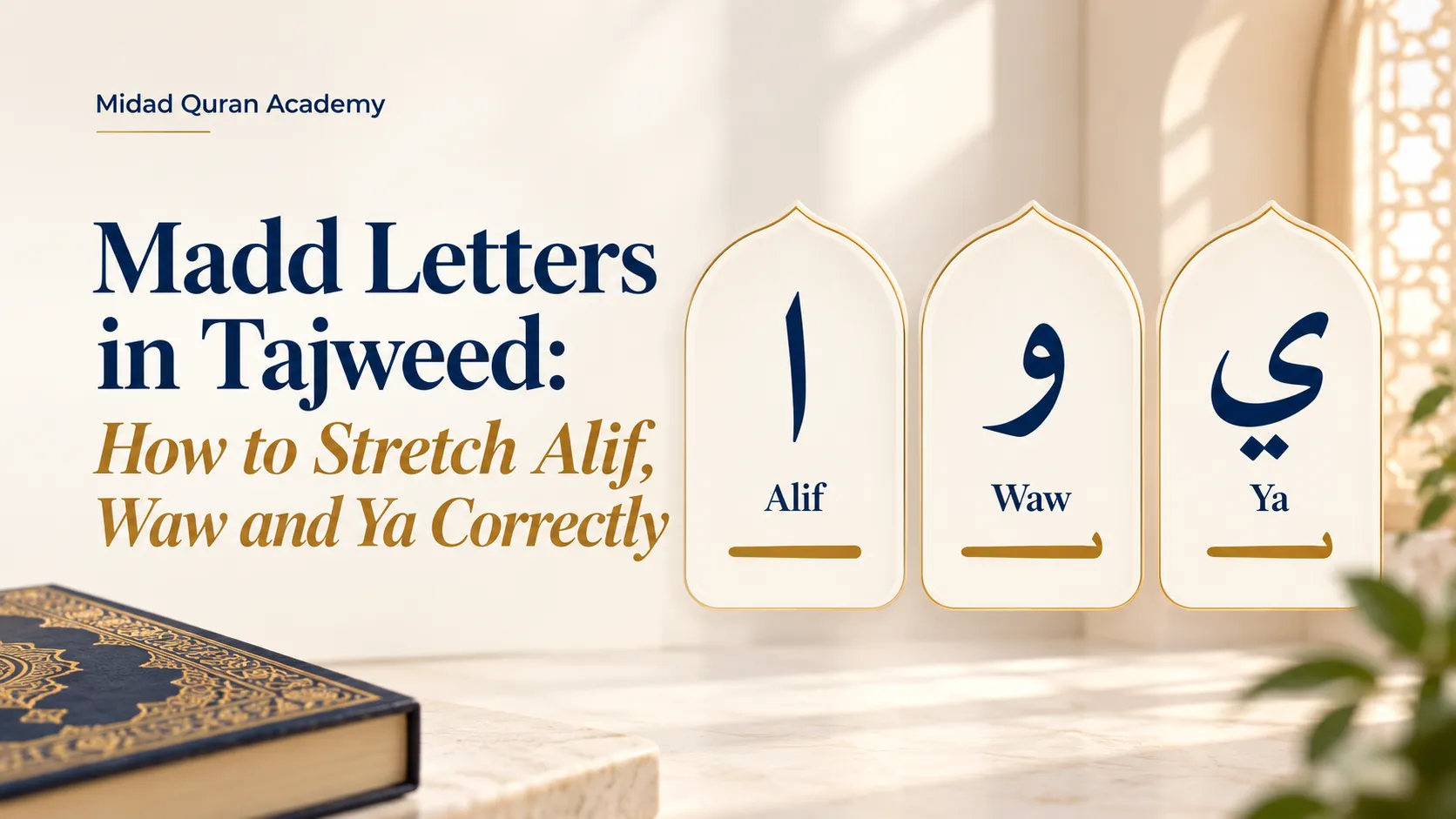
The three Madd letters (Huroof-e-Maddah) are Alif (ا), Waw (و) and Ya (ي). When they meet the correct conditions for natural Madd, they extend the preceding vowel for two counts.
The challenge is learning to recognise when these letters require lengthening and then applying the right length consistently.
What Are the Three Madd Letters?
In Tajweed, Madd means lengthening a vowel sound. The letters that produce the three basic long-vowel sounds are called Huroof al-Madd (حروف المد), also commonly called Maddah letters.
They are:
| Madd letter | Condition | Example |
|---|---|---|
| Alif (ا) | The letter before it has Fathah (َ) | قَالَ |
| Waw (و) | Waw has Sukoon and the preceding letter has Dammah (ُ) | يَقُولُ |
| Ya (ي) | Ya has Sukoon and the preceding letter has Kasrah (ِ) | قِيلَ |
Let's understand these examples.
In قَالَ (qāla), the Fathah before Alif produces a long aa sound.
In يَقُولُ (yaqūlu), the Waw extends the oo sound.
In قِيلَ (qīla), the Ya extends the ee sound.
These words occur in the Quran, including Al-Baqarah 2:30, 2:8 and 2:11.
An important detail is that not every Alif, Waw or Ya you see automatically creates a Madd. The preceding vowel and the letter's condition matter.
For example, Waw and Ya can serve other purposes in Arabic words. A learner must look at the reading signs rather than simply stretching whenever one of these letters appears.
This is why understanding the basic signs taught in Noorani Qaida is so important.
How Long Should We Stretch Madd Letters?
When these three letters form a natural Madd, the sound is stretched for two Harakat, or two counts.
This basic lengthening is called Madd Asli (المد الأصلي) or Madd Tabi'i (المد الطبيعي).
But what does two counts actually mean?
It does not mean holding a sound for exactly two seconds on a clock. The counts follow the pace of recitation. A qualified teacher helps the learner hear and reproduce a consistent length.
Think again about قَالَ.
The learner should not rush past the Alif, but neither should they hold it for an unnecessarily long time. The aim is the natural two-count length.
The same principle applies to the Waw in يَقُولُ and the Ya in قِيلَ.
A learner who understands this difference between short and long vowel sounds has built an important foundation for further Tajweed.
Three Madd Letter Mistakes We Have Observed in Quran Learning
At Midad Quran Academy, one issue we have noticed during teaching is that learners sometimes become confused about which sounds need to be extended and how long they should last.
Interestingly, this concern also came up during a recent teacher recruitment interview.
When we asked a prospective Quran teacher about common recitation mistakes, she independently mentioned confusion about Madd letters. Her observation reflected a difficulty we had also noticed during teaching.
These are practical teaching observations, not findings from a formal statistical study. Still, they help explain where learners may need additional attention.
1. Not Stretching a Madd Letter
This happens when a learner recognises a word but reads its long vowel almost like a short vowel.
Take قَالَ.
The Alif requires the preceding vowel sound to be lengthened. If the learner reads that sound too quickly, the natural Madd has not been given its proper length.
This may happen because the learner is concentrating on recognising the letters and does not notice the lengthening pattern.
How to correct it: First, ask the learner to identify the Alif and the Fathah before it. Once they recognise why the sound is long, the teacher can demonstrate the correct two-count reading and listen as the learner tries again.
2. Stretching a Sound That Should Remain Short
Another mistake is adding length where the reading signs do not require it.
For example, an ordinary short Fathah does not automatically become a long aa sound. The learner must distinguish a short vowel from a vowel extended by a valid Madd letter.
A useful beginner comparison is:
- بَ — a short vowel sound.
- بَا — a long vowel sound created by Alif.
The learner can see the difference on the page and then hear it through a teacher's demonstration.
How to correct it: Practise short and long sounds side by side. Ask the learner to identify which written example contains a Madd letter before attempting the pronunciation.
The goal is to connect the length of the sound with what is actually written.
3. Stretching a Madd Letter Too Much
Sometimes learners understand that Alif, Waw and Ya create long sounds but extend them beyond the required length.
For example, they may recognise the Madd in قَالَ yet hold its vowel as though it needs a much longer stretch.
This is a different problem from missing the Madd completely.
The learner knows that lengthening is required but has not yet learned to control its duration.
How to correct it: The teacher can return to a few simple natural Madd examples and demonstrate the same two-count length repeatedly.
Instead of immediately introducing more complex Madd categories, the learner can focus on keeping these basic long vowels consistent.
It is important to remember that the correct Tajweed rule determines the length. A longer sound is not necessarily a more accurate sound.
Why Do Learners Confuse Short and Long Sounds?
It can be tempting to think that simply memorising the three Madd letters will solve the problem.
But recognising the names Alif, Waw and Ya is only the beginning.
When reading Arabic, a learner has to perform several tasks together. They need to recognise the letter, notice its vowel sign, decide whether lengthening is required and pronounce the sound correctly.
In an isolated exercise, these tasks may feel manageable. When several rules appear in a longer Quranic word, the learner may become distracted by another part of the reading.
This is one reason basic reading exercises should involve more than repetition.
A learner should gradually become able to identify why a sound is long or short, not simply repeat a familiar example from memory.
A Simple Exercise for Practising Alif, Waw and Ya
Here is a teacher-guided exercise for recognising natural Madd.
Start with these three words:
| Word | Madd letter | Natural length |
|---|---|---|
| قَالَ | Alif | 2 counts |
| يَقُولُ | Waw | 2 counts |
| قِيلَ | Ya | 2 counts |
Step 1: Find the Madd letter.
Ask the learner to point out the Alif, Waw or Ya that produces the long vowel.
Step 2: Check the preceding sign.
Does the letter before Alif have Fathah? Is Waw preceded by Dammah? Is Ya preceded by Kasrah?
Step 3: Read with the teacher.
The teacher demonstrates the correct sound length. The learner repeats and receives correction where needed.
Step 4: Change the order.
Present the three examples in a different order and ask the learner to identify each Madd letter again.
This helps check whether they recognise the rule independently rather than depending on the order of a memorised lesson.
Step 5: Apply the rule in Quran Reading.
Once the learner understands the isolated examples, the teacher can select a suitable Quranic passage containing familiar Madd patterns.
The aim is to move gradually from recognising a rule to applying it during recitation.
Written examples are helpful, but a page cannot reproduce correct pronunciation or timing by itself. Listening and correction remain essential.
Are Madd Muttasil and Madd Munfasil the Same as Madd Letters?
No. They are connected concepts, but they describe different things.
Madd letters are the letters Alif, Waw and Ya when they meet the conditions for lengthening.
Madd Muttasil and Madd Munfasil are names of particular Madd rules that apply when Hamzah follows a Madd letter.
For example:
- Madd Muttasil: The Hamzah follows the Madd letter within the same word, as in جَاءَ.
- Madd Munfasil: The Madd letter comes at the end of one word and Hamzah begins the next, as in يَا أَيُّهَا when read continuously.
These rules can require longer lengths than natural Madd, according to the recognised recitation method being followed.
They are worth learning, but beginners do not need to tackle every advanced Madd rule before becoming comfortable with the basic letters.
First recognise the Madd letters. Then learn to apply their natural length correctly. After that, more advanced lengthening rules become easier to understand.
How Can Parents Help Their Children Practise?
If your child is learning Madd letters, you don't have to know every Tajweed rule to support them.
Begin by asking the teacher which Madd patterns the child is currently practising.
At home, you can ask your child to identify the Madd letter in a familiar exercise and show which reading sign comes before it.
That encourages understanding without turning every practice session into a test.
For pronunciation and length, use the teacher's demonstration or a recording the teacher recommends. If you are uncertain about a sound yourself, it is better to ask the teacher than to introduce a correction you cannot verify.
And when your child struggles with the same example repeatedly, focus on that one difficulty rather than moving through several more pages.
The aim is careful, meaningful improvement—not simply finishing a lesson quickly.
Correct Madd Is About Giving a Sound Its Proper Length
The three Madd letters may look simple, but learning to use them correctly makes a real difference to Quran reading.
A learner needs to recognise Alif, Waw and Ya, understand the signs that make them Madd letters and give natural Madd its proper two-count length.
The mistakes we have observed—missing the stretch, adding length to the wrong sound and overstretching—show why this foundational lesson deserves attention.
With clear explanation, suitable examples and careful correction, learners can begin applying these rules more consistently in their recitation.
At Midad Quran Academy, our one-to-one Practical Tajweed classes focus on helping learners understand and apply recitation rules through individual guidance and correction.
Because learning Tajweed is not simply about knowing the names of rules. It is about learning to recite with care and accuracy.
