

You open an English translation of the Quran and read a verse. You understand the words, but a question remains: What exactly is this verse teaching, and how does it connect with the verses around it?
Perhaps you've experienced this while reading a familiar Surah. You know what its translation says, yet you're unsure whether you've understood its fuller message.
This is where Tafseer becomes useful.
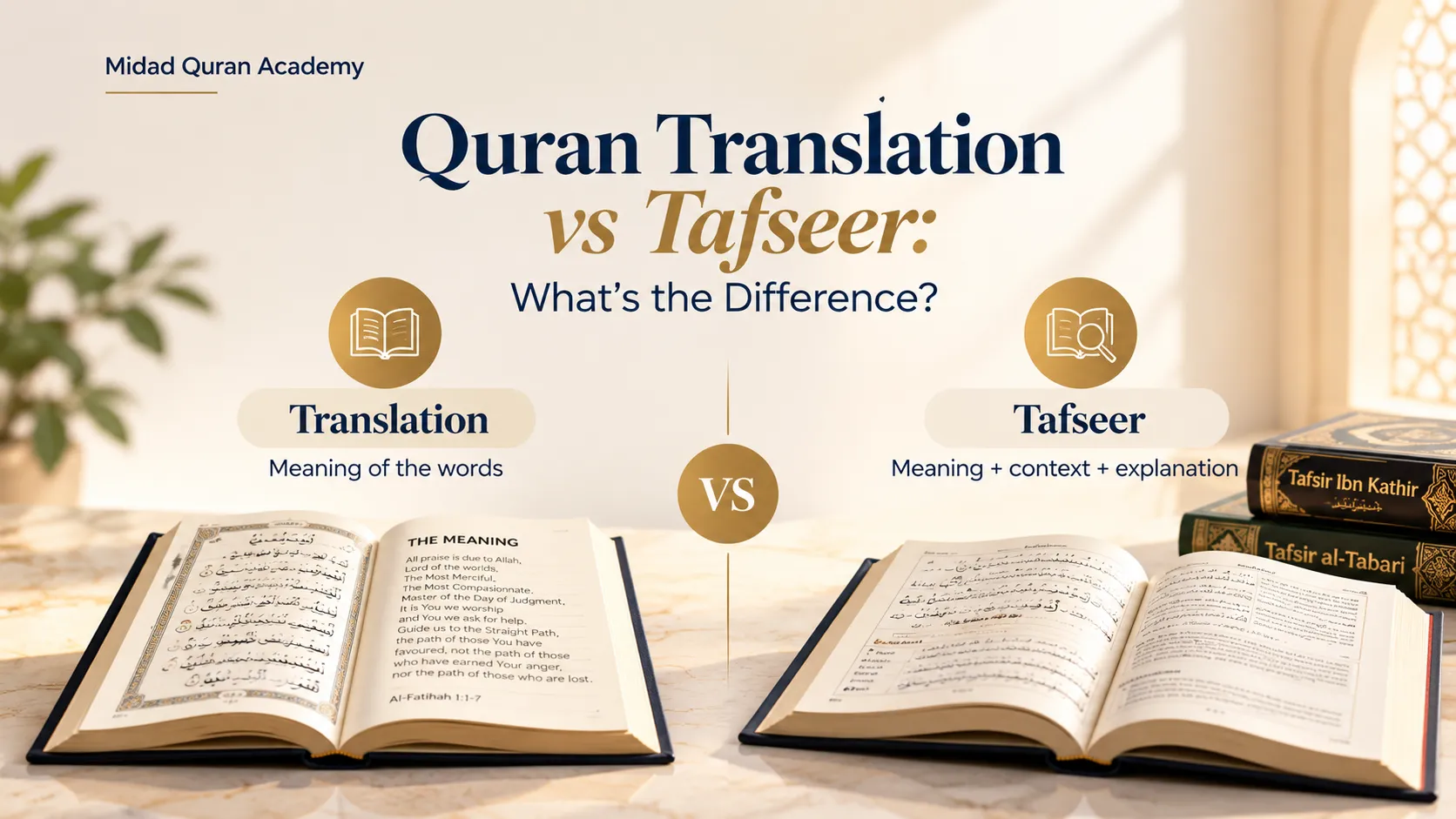
Quran translation communicates the meaning of Quranic words and verses in another language. Tafseer goes further by explaining their meaning, relevant context, connections and scholarly interpretation.
Both have value. Translation gives you an accessible starting point, while Tafseer helps you study what you are reading more carefully.
Let's understand the difference through a practical Quranic example.
What Is Quran Translation?
The Quran was revealed in Arabic. A translation helps someone who does not fully understand Arabic access its meanings in a language they know.
For example, an English translation can help you understand what a Surah says about faith, worship, patience or human responsibility.
This is valuable because not everyone who can recite the Quran also understands the Arabic language.
But translation involves choices.
Sometimes an Arabic word has a range of meanings, or its meaning depends on how it is used in a particular verse. The translator must choose English words that communicate the intended meaning as faithfully as possible.
As a result, two respected translations may use slightly different English expressions for the same Ayah.
That does not automatically mean one translation is wrong.
It means language is not always a matter of replacing one word with one equivalent word.
Some translations also include footnotes or brief explanations to clarify meanings that cannot easily be conveyed in a short sentence.
A good translation is an important learning resource. However, reading the translated words does not always answer every question about the verse.
That is where Tafseer can add depth.
What Is Quran Tafseer?
Tafseer (تفسير) is the scholarly explanation and interpretation of the Quran.
It helps learners understand what an Ayah communicates by considering its Arabic wording, its place within the passage, relevant explanations from the Quran and Sunnah, and the work of recognised scholars.
Depending on the verse, Tafseer may explore:
- The meaning of important Arabic words and expressions.
- How one Ayah connects with the verses before and after it.
- The central theme of a Surah.
- Relevant explanations from the Prophet Muhammad ﷺ and early Islamic scholarship.
- Historical circumstances or reasons for revelation, where reliably established.
- Interpretive questions on which qualified scholars have discussed different views.
Not every verse has a documented incident behind its revelation. Tafseer should not invent one simply to make an explanation more interesting.
Likewise, not every verse needs a long historical discussion. Sometimes understanding its language and its relationship with the surrounding passage is the most useful starting point.
Classical scholars such as Ibn Kathir and Al-Tabari produced extensive works of Tafseer. Their explanations remain important references for Quran study.
Tafseer, therefore, isn't simply someone's personal impression of a verse. Responsible study distinguishes established scholarly explanations from personal reflection.
Quran Translation vs Tafseer: The Main Differences
Here is a simple comparison.
| Quran translation | Quran Tafseer |
|---|---|
| Communicates the meanings of Quranic words and verses in another language. | Explores and explains the meanings in greater depth. |
| Helps readers understand what a passage says. | Helps readers understand how it is explained and interpreted. |
| Usually follows the Quran verse by verse. | May also examine relationships between verses and wider themes. |
| May include short explanatory notes. | Can draw extensively on Arabic language, Hadith and established scholarly commentary. |
| Useful as a starting point for understanding. | Useful for studying passages more carefully and resolving questions. |
The two are not competing ways of learning.
In fact, Tafseer lessons often begin with translation.
A learner first understands the general meaning of the Ayah. Then the teacher explains what needs further attention.
Let's see how that works.
An Example from Surah Al-Asr: What Tafseer Adds
Surah Al-Asr is one of the shortest Surahs in the Quran. It contains just three Ayahs.
You may already know it by heart.
Its short length makes it a helpful example because we can look at the whole Surah without losing sight of its message.
You can read the complete Surah with an English translation at Quran.com — Surah Al-Asr.
Step 1: Understand the Translation
The opening Ayah is:
وَالْعَصْرِ
It is commonly translated as an oath by time.
The second Ayah tells us that humanity is in a state of loss.
The third Ayah identifies those who are excepted from that loss: people who have faith, do righteous deeds, encourage one another towards truth and encourage one another towards patience.
Even from this brief translation, we can recognise the Surah's main message.
It is not simply a statement about time. It is a reminder about how human life is lived and what truly matters.
But we can go further.
Step 2: Explore What the Opening Means
When you read the first Ayah in translation, you may wonder why the Surah begins with an oath by time.
Classical Tafseer helps us examine that question.
In his explanation of Surah Al-Asr, Ibn Kathir discusses time as the setting in which human actions take place, whether good or bad.
Al-Tabari also records scholarly explanations of the expression Al-Asr, including its relationship to time and particular parts of the day.
These explanations help us recognise that the opening expression is not an isolated mention of time.
It introduces the serious statement that follows about the condition of human beings and the importance of how they live.
The English translation communicates the verse, while Tafseer helps explain its significance within the Surah.
You can examine the relevant commentary in Tafseer Ibn Kathir on Surah Al-Asr and Al-Tabari's Arabic Tafseer.
Step 3: Connect the Three Ayahs
Now look at the Surah as a whole.
It begins with an oath by time, states that humanity is in loss, and then explains the exception.
That exception contains four connected qualities:
- Faith.
- Righteous deeds.
- Encouraging one another towards truth.
- Encouraging one another towards patience.
Ibn Kathir's Tafseer explains these qualities as belonging together in the description of those excepted from loss.
This matters because someone reading only the opening Ayah might concentrate entirely on the word time.
Reading the full Surah reveals the message. Studying its Tafseer helps the learner understand how the opening, warning and exception relate to one another.
That is the practical difference: translation helps you follow what the verses say; Tafseer helps you explore how their meanings fit together and what recognised scholarship explains about them.
Why Is Context Important When Reading the Quran?
Imagine opening a book in the middle of a conversation.
You understand every sentence on the page, but you don't know what was said immediately before it.
You may still understand part of the message. However, reading the surrounding conversation might change how you understand a particular statement.
Quranic passages also need careful attention to context.
Sometimes an Ayah continues a subject introduced earlier. Another may answer a question, introduce a new point or make an exception to a general statement.
If we isolate the verse, we may overlook that relationship.
Context in Tafseer can involve several things:
The surrounding Ayahs. What comes before and after the verse?
The Surah's wider subject. How does this passage contribute to the larger message?
The Arabic expression. Does the wording have a significance that requires explanation?
Reliable historical evidence. Is there an established report that helps explain the circumstances of revelation?
The important word is reliable.
A teacher should not create a dramatic historical story merely because it makes the lesson more engaging. When a reported background is uncertain, that uncertainty should be made clear.
And when scholars offer different established interpretations, the learner should not be told that one unsupported personal opinion is unquestionably the only explanation.
Can You Understand the Quran Through Translation Alone?
Yes, a reliable translation can help you understand many of the Quran's teachings and reflect on them.
You don't have to wait until you have studied years of Arabic grammar or completed a Tafseer course before reading a translation.
For many learners, translation is their first meaningful introduction to understanding the Quran beyond recitation.
The important thing is recognising its limits.
You may read an Ayah and understand its general message clearly. On another occasion, you may encounter a passage involving legal rulings, historical events or an expression that needs further explanation.
In those cases, a recognised Tafseer and guidance from a suitably qualified teacher become particularly valuable.
There is also a difference between personal reflection and claiming to establish an authoritative interpretation.
You might reflect on how Surah Al-Asr encourages you to use your time responsibly. That is a personal learning reflection.
But if you begin making detailed religious rulings from isolated English wording, without examining the relevant scholarship, you risk going beyond what the translation can support.
Translation is a valuable beginning. Tafseer helps learners approach more difficult questions with appropriate evidence and care.
A Simple Way to Study Translation and Tafseer Together
If you're new to studying Quranic meanings, you don't need to begin with a large collection of commentary books.
Choose a short Surah and follow a manageable learning process.
First, read the complete passage.
Begin with the Arabic if you can read it, alongside a reliable translation in your preferred language.
Second, identify the central message.
Try explaining, in your own words, what the passage is communicating.
Third, notice anything you don't understand.
Perhaps you want to know why a particular expression was used, how two Ayahs connect or what a reference means.
Fourth, consult a reliable Tafseer.
Look for an explanation from an established source. Avoid building conclusions from random quotations or unattributed social media posts.
Finally, make a short note.
Write down the verse reference, what you understood from the translation, what the Tafseer clarified and any question that remains.
For Surah Al-Asr, your note might record that the three Ayahs form one connected message, rather than treating the opening reference to time separately from the rest.
This process does not make someone a qualified Quran commentator. It simply provides a more careful way to learn from reliable explanations.
How Does Midad Quran Academy Teach Quran Tafseer?
At Midad Quran Academy, our Tafseer teaching approach begins with reading the Ayahs, understanding their translation and then exploring their explanation and connections through dependable sources.
Our introductory pathway starts with Surah Al-Fatihah.
After that, learners study the last ten Surahs of the Quran, from Surah Al-Fil to Surah An-Nas, before moving into a longer sequential study beginning with Surah Al-Baqarah.
This gives learners an opportunity to become familiar with the Tafseer learning process through shorter passages before studying longer connected sections.
Each one-to-one Tafseer lesson is adapted to the learner's starting knowledge and learning goals.
The teacher explains meanings, uses relevant established scholarly references, discusses reliable context where available and helps the learner connect the Ayahs.
Learners are encouraged to make notes, review explanations and ask questions about what they have studied.
The purpose isn't simply to memorise another person's explanation.
It is to develop a clearer understanding of the Quranic passages being taught, while respecting the knowledge and responsibility involved in interpreting them.
Translation Opens the Meaning; Tafseer Helps You Explore It
Translation and Tafseer both have an important place in Quran learning.
A translation allows you to approach the meanings of the Quran in a language you understand. Tafseer helps you examine the explanation, context and connections that may not be obvious from the translated words alone.
You don't need to choose one and abandon the other.
Begin by understanding what the Ayahs say. Then use reliable Tafseer to understand their message more carefully.
If you would like guided support, you can explore Midad Quran Academy's one-to-one Quran Tafseer classes.
We offer three free trial classes before payment, giving learners an opportunity to experience our approach and discuss their starting level and learning goals.
