
Online Tajweed Classes for Clearer, More Accurate Quran Recitation. Apply Tajweed While You Recite.
Learn Quran online with Tajweed through live one-to-one classes for children, teenagers, and adults who can already read the Quran. We explain each rule clearly, show how it affects the recitation, correct mistakes as they happen, and help you apply Tajweed during real Quran reading. The focus is not simply knowing rule names. It is recognising and using them correctly while you recite. Learn each Tajweed rule clearly, apply it while reading the Quran, and receive live correction until the recitation becomes more accurate.

Learn each Tajweed rule clearly, apply it while reading the Quran, and receive live correction until the recitation becomes more accurate.
3 Free Trial ClassesFor Learners Who Can Read the Quran but Need Better Tajweed.
This course is for children, teenagers, and adults who can already read Quranic text but need help improving pronunciation, applying Tajweed rules, correcting recurring mistakes, or gaining better control during recitation.For learners who can already read the Quran but need stronger pronunciation, rule application, and recitation control.
You Know Some Rules but Struggle to Apply ThemRULES ARE HARD TO APPLY
You may recognise terms such as Madd, Ghunnah, Ikhfa, or Qalqalah but find it difficult to notice and apply the rules while actually reciting.You know some rules but miss them while actually reciting.
Pronunciation Mistakes Keep ReturningSOUNDS NEED CORRECTION
Some letter sounds, Makharij, heavy and light sounds, or other pronunciation mistakes continue even though you have been reading for some time.Makharij or repeated pronunciation mistakes still need attention.
Your Recitation Needs Better ControlRECITATION FEELS INCONSISTENT
You can read the Quran, but pace, lengthening, pauses, or rule application become inconsistent when the recitation continues.Pace, Madd, pauses, or other rules change from one passage to another.
You Want a Stronger Base Before HifzPREPARING FOR HIFZ
Better Tajweed can help prevent recurring pronunciation and rule-application mistakes from becoming part of memorisation and revision.You want stronger recitation before building a regular Hifz routine.
If Arabic letters, joining words, or basic Quran reading still need work, Noorani Qaida or Quran Reading may be the better first step. We can identify this during the trial classes.If basic Quran reading still needs work, Noorani Qaida or Quran Reading may be the better first step.
GET COURSE GUIDANCEAlready Reading Quran? Build Better Tajweed.
This course is for learners who can already read but need stronger pronunciation, rule application, and recitation control.
You can read the text, but the recitation still needs correction.
Rules Are Hard to Apply
You know some rules but miss them while actually reciting.
Sounds Need Correction
Makharij or repeated pronunciation mistakes still need attention.
Recitation Feels Inconsistent
Pace, Madd, pauses, or other rules change from one passage to another.
Preparing for Hifz
You want stronger recitation before building a regular Hifz routine.
Move From Knowing Tajweed Rules to Applying Them in Recitation.Turn Tajweed Rules Into Better Recitation.
An online Tajweed course should improve what happens while you are actually reading the Quran. MIDAD focuses on pronunciation, practical rule application, recitation control, repeated mistakes, and the learner’s ability to notice what needs correction.Learn to recognise the rule, hear the difference, and apply it more accurately while reading the Quran.
Makharij & Clearer PronunciationMAKHARIJ & PRONUNCIATION
Work on articulation points, letter sounds, and common pronunciation mistakes so similar sounds become easier to distinguish and recite correctly.Clearer letter sounds and pronunciation.
Tajweed Becomes Useful Inside the Recitation.PRACTICAL DIFFERENCE
Knowing a rule is only the beginning. The real skill is recognising where it applies and using it correctly while reading the Quran.Know the rule, recognise it, and apply it while reading.
Practical Rule ApplicationRULE APPLICATION
Apply rules such as Madd, Ghunnah, Qalqalah, Noon and Meem rules, and other relevant Tajweed principles directly during Quran recitation.Use Tajweed while actually reciting.
Better Pace, Pauses & ControlRECITATION CONTROL
Learn to slow down where needed, respect lengthening and stopping points, and maintain better control instead of rushing through the recitation.Better pace, Madd, pauses, and attention.
Recurring MistakesREPEATED MISTAKES
Mistakes that repeatedly return are corrected, practised, and reviewed so the learner becomes more aware of them during later recitation.Notice and correct errors that keep returning.
Recitation Awareness & ConfidenceRECITATION AWARENESS
With regular correction and practice, the learner becomes better able to notice what sounds right, what needs attention, and when to ask for help.Know what sounds stronger and what still needs work.
The goal is not to collect more Tajweed terminology. It is to apply Tajweed more accurately and consistently while reciting the Quran.The goal is to apply Tajweed more accurately and consistently while reciting.
Turn Tajweed Rules Into Better Recitation.
Learn to recognise the rule, hear the difference, and apply it more accurately while reading the Quran.
Know the rule → recognise it → apply it while reading.
Learn the Rule, Hear the Difference, Then Apply It in Recitation.Learn the Rule. Use It While Reading.
Tajweed is difficult to improve through theory alone. In each one-to-one lesson, the teacher explains the relevant rule, demonstrates how it affects the sound, listens to the learner apply it, corrects mistakes immediately, and returns to weak areas when they appear again.The teacher explains, demonstrates, listens, corrects, and helps you practise the rule inside real Quran recitation.

A rule is learned properly when the learner can recognise and apply it while reciting.The rule matters when you can use it while reciting.
Understand the RuleUNDERSTAND
Learn what the Tajweed rule means, where it appears, and what it changes in the recitation.Know what the rule means and where it applies.
Hear the DifferenceHEAR
The teacher demonstrates the sound, length, articulation, pause, or pronunciation so the learner can hear what needs to change.Listen to the correct sound, length, or pronunciation.
Apply It While ReadingAPPLY
The learner uses the rule directly in Quran recitation instead of leaving it as a separate theory exercise.Use the rule while reading the Quran.
Correct and RepeatREPEAT
Mistakes are corrected as they happen, then the learner repeats the reading with guidance until the correction becomes clearer.Practise the correction with live teacher guidance.
Review When It ReturnsREVIEW
If the same Tajweed mistake appears again in later recitation, it becomes part of the lesson again instead of being ignored.Return to repeated mistakes when they appear again.
Explain it. Hear it. Apply it. Correct it. Practise it again.Learn → Apply → Correct → Repeat
Learn the Rule. Use It While Reading.
The teacher explains, demonstrates, listens, corrects, and helps you practise the rule inside real Quran recitation.

Live Tajweed Correction With Progress You Can See.
Tajweed progress should appear in the learner’s actual recitation. We correct mistakes while the Quran is being read, record recurring weak areas, and keep the next priority visible.
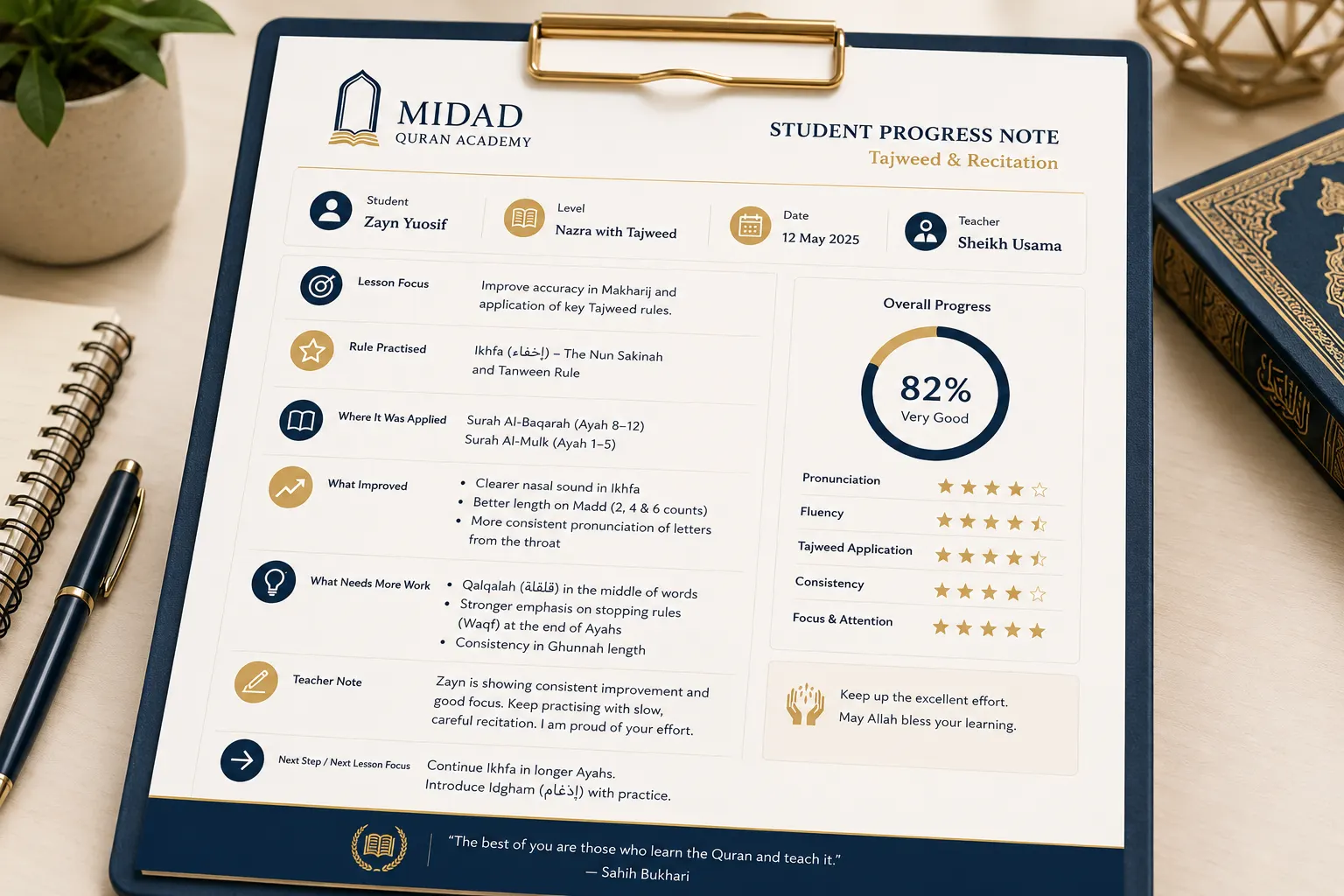
What was corrected. Where it was applied. What still needs attention.
Makharij & Letter Sounds
Unclear articulation points, similar letter sounds, and pronunciation that becomes too heavy, too light, or otherwise inaccurate.
We note which sounds were practised, which became clearer during recitation, and which still need focused correction.
Tajweed Rules in Recitation
Rules the learner understands in theory but misses, confuses, or applies inconsistently while reading the Quran.
We record where the rule was applied correctly and where teacher prompting is still needed.
Madd, Pace & Recitation Control
Rushed reading, inconsistent lengthening, and loss of control when several rules appear within the same passage.
Progress becomes visible when the learner maintains more accurate timing and a steadier recitation with less prompting.
Waqf, Pauses & Flow
Weak stopping points, awkward pauses, or reading that continues without enough attention to where and how the recitation should stop.
Repeated stopping and flow problems stay in the progress record until the learner applies them more consistently.
Recurring Mistakes & Next Priority
Mistakes that continue returning after earlier explanation and practice.
The learner moves forward when improvement begins appearing consistently in recitation, not simply because the rule has already been explained once.
Live Tajweed Correction With Progress You Can See.
Tajweed progress should appear in the learner’s actual recitation. We keep recurring weak areas visible, show what is becoming stronger, and make the next priority clear.
Tajweed Progress Snapshot
Rule application is becoming more consistent. Keep Ghunnah and stopping points as the next focused practice area.
What Was Corrected
Important pronunciation and Tajweed mistakes stay visible instead of disappearing after class.
What Improved
See where recitation is becoming clearer, steadier, and more accurate.
What Comes Next
The next lesson priority remains clear, so weak areas are revisited instead of forgotten.
Correct the Mistake. Track What Improves.
See which Tajweed areas were corrected, what became stronger, and what still needs practice.
Tajweed Progress Snapshot
Recitation is becoming more controlled. Rule application is stronger, while repeated pronunciation and pause mistakes still need guided practice.
Strengthen Ghunnah and stopping points.
These areas return in the next lessons until the improvement becomes more consistent.

Build a Stronger Base for What Comes Next.Build a Stronger Base for What Comes Next.
Stronger Tajweed does more than improve one lesson. When pronunciation, rule application, pauses, and recurring mistakes become more controlled, the learner has a better foundation for regular Quran reading, revision, and memorisation.Better Tajweed supports clearer recitation, stronger revision, and more accurate memorisation.

Clearer RecitationCLEARER RECITATION
Apply Tajweed with better pronunciation and greater control instead of relying on the teacher to identify every mistake.Better pronunciation and rule application.
Stronger Hifz PreparationHIFZ PREPARATION
Begin memorisation with fewer recurring pronunciation and Tajweed mistakes that would otherwise need correcting again during revision.Fewer repeated recitation mistakes entering memorisation.
Better RevisionBETTER REVISION
Review memorised portions with stronger rule application and more awareness of mistakes that tend to return.Stronger rule application during revision.
More Focused PracticeFOCUSED PRACTICE
Know which Makharij, rules, pauses, or repeated errors deserve attention instead of practising without a clear purpose.Know exactly what needs correction next.
A Clear Next Learning StepNEXT LEARNING STEP
Continue with Hifz, stronger recitation, regular Quran reading, or further Tajweed development from a more reliable foundation.Move forward from a stronger Tajweed foundation.
Build a Stronger Base for What Comes Next.
Better Tajweed supports clearer recitation, stronger revision, and more accurate memorisation.

Know the Standards Behind Every MIDAD Tajweed Class.
Practical Tajweed depends heavily on the person listening and correcting the recitation. MIDAD checks teacher qualifications, assesses Quran recitation and Tajweed application, supervises classes live, and keeps learning progress visible.
Qualified Quran Teachers
Teachers are Hafiz-e-Quran, with relevant Tajweed qualifications and documents reviewed before they are assigned to regular classes.Hafiz-e-Quran with Tajweed documents reviewed.
Recitation & Tajweed Assessed
A teacher’s Quran recitation, pronunciation, and practical Tajweed application are assessed before regular teaching begins.Quran recitation and practical Tajweed checked.
Live Class Supervision
Classes are supervised live to support responsible teaching and help maintain consistent learning standards.Classes supported through live oversight.
Progress Communication
Learners and, for younger students, parents receive clear information about what was practised, what improved, and what still needs attention.Know what improved and what still needs attention.
CLEAR STANDARDS. VISIBLE RESPONSIBILITY.
You should not have to guess how the teacher was checked, what is being corrected, or where the learner still needs support.Know how teaching is checked, supervised, and kept visible.
Know What Supports Every Tajweed Class.
Teacher checks, recitation assessment, live supervision, and progress visibility sit behind every regular class.
Four checks before trust is earned.
Experience the Tajweed Teaching Before You Enrol.
Use the trial to experience how the teacher listens to your recitation, explains the relevant Tajweed rule, corrects mistakes, and guides you through practice.
Book Your Free Tajweed Trial
Share a few details. We’ll contact you to arrange three free trial classes at a suitable time.
Clear Monthly Plans for Practical Tajweed Classes.
Choose how often you or your child studies Practical Tajweed each week and see the monthly fee clearly before enrolment. Start with three free trial classes and choose a regular plan only if you decide to continue.
3. Choose classes per week
30-minute live one-to-one classes5 Days / Week
Five 45-minute one-to-one classes each week for memorisation, revision, listening, and correction.
3 days per week · 30-minute one-to-one classes
Questions About Online Tajweed Classes and Quran RecitationQuestions Before Starting Tajweed
Find clear answers about who can join, the reading level needed before Tajweed, the rules covered, one-to-one correction, progress tracking, Hifz preparation, and the free trial.Quick answers about readiness, rules, live correction, progress, and the free trial.
Children, teenagers, and adults can join if they can already read Quranic text and want to improve pronunciation, Tajweed rule application, or overall recitation quality. Lessons are adjusted to the learner’s current level rather than age alone.Children, teens, and adults who can already read the Quran and want better Tajweed can join.
Usually, yes. This Practical Tajweed course is designed for learners who can already read the Quran at a basic level. If Arabic letters, joining, or basic reading still need work, Noorani Qaida or Quran Reading may be the better starting point.Usually, yes. If basic reading still needs work, Qaida or Quran Reading may be the better first step.
Quran Reading focuses mainly on recognising and joining words, pronunciation, fluency, and becoming a more independent reader. Practical Tajweed goes deeper into Makharij, rule application, Madd, Ghunnah, Qalqalah, stopping, and correcting how those rules are applied during recitation.Quran Reading builds reading ability and fluency. Tajweed focuses more deeply on rule application and precise recitation correction.
The exact focus depends on the learner’s level. Lessons may include Makharij, Sifaat, Madd, Ghunnah, Qalqalah, Noon Sakinah and Tanween, Meem Sakinah, heavy and light sounds, stopping and pausing, and other rules that appear in the learner’s recitation.Lessons may include Makharij, Madd, Ghunnah, Qalqalah, Noon and Meem rules, pauses, and other areas needed in your recitation.
The learner recites live while the teacher listens closely. When a sound is unclear, the teacher demonstrates the correct pronunciation, explains what needs to change, and asks the learner to repeat it until the difference becomes clearer.Recite live, hear the correct sound from the teacher, then repeat it with direct correction.
Yes. Regular Tajweed classes are live and one-to-one. This gives the teacher time to listen to the learner’s actual recitation, correct mistakes immediately, answer questions, and focus practice on the areas that need the most attention.Yes. The teacher listens and corrects one learner throughout the class.
Yes. Many learners understand Tajweed terminology but struggle to recognise or apply the rules while reading. The course can focus on turning that existing knowledge into more consistent application during real Quran recitation.Yes. We can focus on applying what you know more consistently while reciting.
We keep track of the rules and pronunciation areas practised, recurring mistakes, improvements that appear in recitation, and the next areas that need attention. Adult learners can follow their own progress, while parents remain informed for younger students.See what was practised, what improved, which mistakes still return, and what needs attention next.
Stronger Tajweed can give Hifz a better foundation because pronunciation and rule-application mistakes are corrected before they become repeated inside memorised portions. Tajweed does not replace a Hifz routine, but it can support more accurate memorisation and revision.Yes. Stronger recitation can help prevent repeated pronunciation and Tajweed mistakes during memorisation.
You or your child joins three live one-to-one Tajweed classes before enrolment. The teacher listens to the current recitation, identifies the main correction needs, demonstrates the teaching approach, and gives you time to experience the classes before choosing a regular plan. No payment is required before the trial.Join three live one-to-one classes, experience the correction and teaching, then decide whether to continue. No payment is required first.
Questions Before Starting Tajweed
Quick answers about readiness, rules, live correction, progress, and the free trial.
01 Who Can Join Tajweed Classes? −
Children, teens, and adults who can already read the Quran and want better Tajweed can join.
02 Do I Need to Read Quran Already? +
Usually, yes. If basic reading still needs work, Qaida or Quran Reading may be the better first step.
03 Quran Reading or Tajweed? +
Quran Reading builds reading ability and fluency. Tajweed focuses more deeply on rule application and precise recitation correction.
04 Which Tajweed Rules Are Covered? +
Lessons may include Makharij, Madd, Ghunnah, Qalqalah, Noon and Meem rules, pauses, and other areas needed in your recitation.
05 How Is Pronunciation Corrected Online? +
Recite live, hear the correct sound from the teacher, then repeat it with direct correction.
06 Are Classes One-to-One? +
Yes. The teacher listens and corrects one learner throughout the class.
07 I Know Some Rules Already. Is That Fine? +
Yes. We can focus on applying what you know more consistently while reciting.
08 How Is Progress Tracked? +
See what was practised, what improved, which mistakes still return, and what needs attention next.
09 Can Tajweed Help With Hifz? +
Yes. Stronger recitation can help prevent repeated pronunciation and Tajweed mistakes during memorisation.
10 How Do the Free Trials Work? +
Join three live one-to-one classes, experience the correction and teaching, then decide whether to continue. No payment is required first.
Experience the Tajweed Teaching Before You Enrol.
Join three live one-to-one Tajweed classes for yourself or your child. See how the teacher listens to the recitation, explains the rules, corrects mistakes, and guides practice before you decide whether to continue.
No payment is required before the trial.
Try the Tajweed Teaching First.
Experience live correction and one-to-one Tajweed teaching before choosing a regular plan.
Try the Tajweed Teaching First.
Experience live correction and one-to-one Tajweed teaching before choosing a regular plan.
Experience the teaching first. Decide after the trial.
