

Your child might know a few daily Duas, the names of the five prayers and several stories about the Prophets.
But how do you know what they should learn next?
Should they focus on memorising more Duas, understanding Islamic beliefs, learning Salah or studying the
Seerah of Prophet Muhammad ?ﷺ
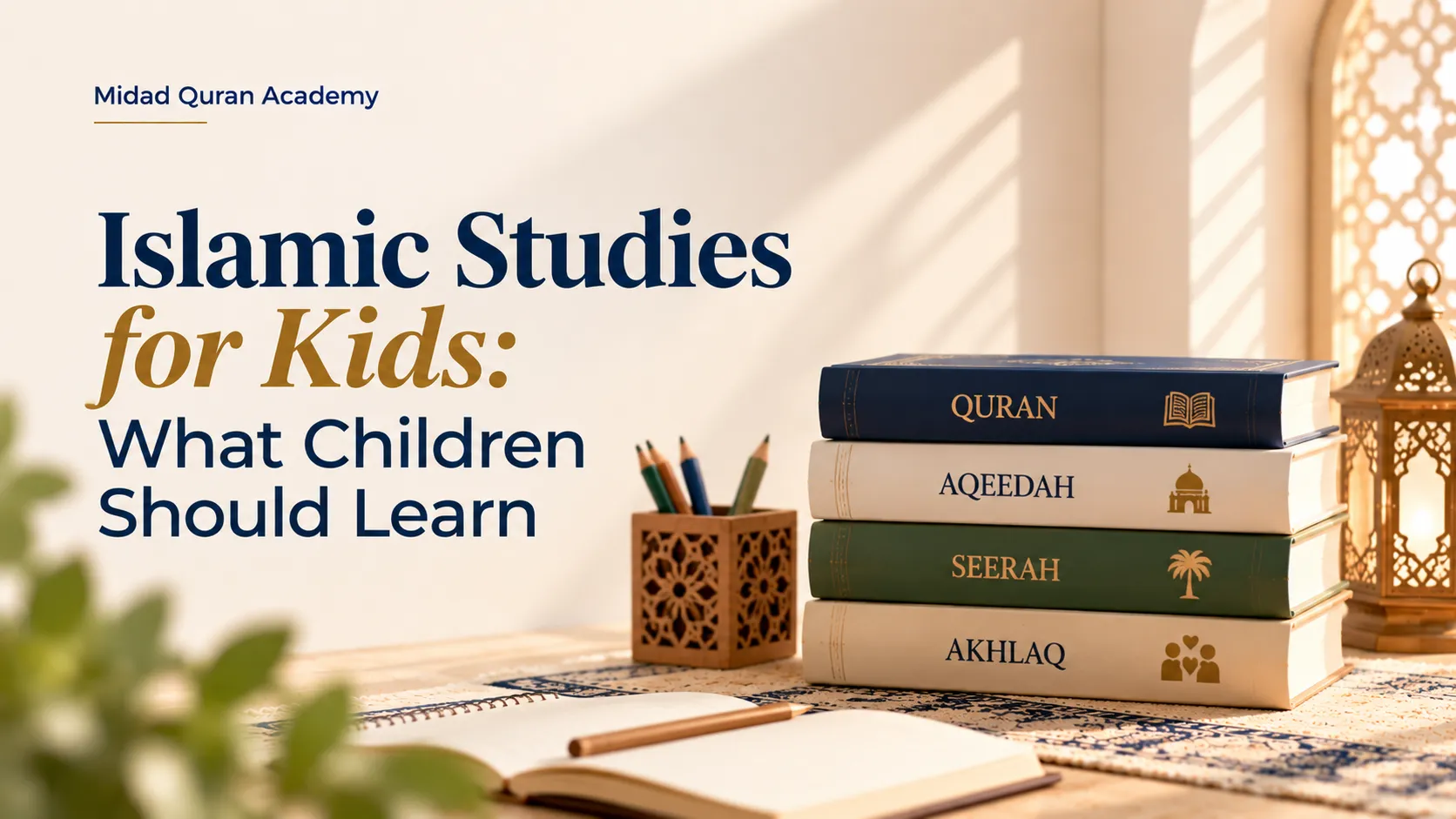
A well-planned Islamic Studies education for children should cover four connected areas: foundational beliefs, Salah and worship, daily Duas and remembrance, and Seerah, Hadith and Islamic character. Children should gradually learn what these teachings mean, remember appropriate texts and understand how to apply their knowledge in everyday life.
The right order and depth depend on what the child already knows. Islamic Studies should build understanding, not simply introduce a longer list of information every month.
What Is the Main Purpose of Islamic Studies for Children?
Islamic Studies introduces children to what Muslims believe, how they worship Allah, the teachings and example of Prophet Muhammad ﷺ, and how Islamic guidance relates to everyday decisions.
Some learning involves memorisation.
Children may need to remember important Islamic statements, words used in Salah, daily supplications and selected Hadith.
Other learning involves understanding and practical demonstration.
A child may know the steps of Wudu but still need support performing them. They may memorise a Dua yet forget when to use it. They may know that honesty is important but need help recognising what honesty means in a difficult situation at school.
These are different parts of learning.
A useful Islamic Studies curriculum therefore considers three questions:
What does the child know? Can they recall the words or information they have been taught?
What does the child understand? Can they explain the main idea in language appropriate to their age? What can the child apply? Can they recognise when the teaching is relevant and demonstrate suitable practical knowledge?
These questions make it easier for parents and teachers to identify meaningful progress.
1. Islamic Beliefs and Foundations
A child's Islamic education should include an introduction to who Allah is, what Muslims believe and why Muslims worship Him.
The explanation should match the child's age, previous learning and ability to understand more abstract ideas.
Foundational topics include belief in Allah and His oneness (Tawhid), the Prophets and Messengers, angels, revealed books, the Last Day and divine decree.
Children should also learn about Prophet Muhammad ﷺas Allah's Messenger and the importance of following the guidance of the Quran and Sunnah.
Teaching Beliefs Through Meaning, Not Just Words
Some Islamic Studies programmes use the six Kalimas and the texts known as Iman-e-Mujmal and Iman-e-Mufassal as introductory learning materials.
At Midad Quran Academy, these are part of our foundational teaching approach.
Children learn the assigned Arabic wording alongside suitable explanations of belief, remembrance of Allah, praise, repentance and other related concepts.
The six-Kalima sequence is a customary educational arrangement in some Muslim communities. It should not be confused with a universally required additional pillar of Islam.
For younger learners, an explanation may be simple.
For example, when discussing Tawhid, a teacher might explain what it means to worship Allah alone and invite the child to ask questions.
An older child may be ready to explore the topic in greater depth.
The goal is not simply for the child to repeat statements of belief but to begin understanding what those statements teach.
2. Salah, Wudu and Basic Worship
Learning how to worship is another important part of Islamic Studies.
A child may know that Muslims perform five daily prayers but not yet understand how to prepare for Salah or what its main actions involve.
A practical learning sequence can begin with Wudu and then introduce the Adhan, daily prayer names and times, Rak'ahs and the basic structure of Salah.
From Knowing the Steps to Performing Them
Consider a child who can explain the steps of Wudu but becomes confused when asked to demonstrate them.
The teacher may need to show the sequence again, ask the child to describe each action and check their practical understanding.
This helps the child move beyond recalling an answer. Salah also requires suitable teaching of its words, movements and conditions.
Children may learn what the Qiblah is, why Muslims pray, how to prepare for Salah and the relevant recitations.
The Quran instructs families to maintain prayer with perseverance in Surah Taha 20:132.
This gives parents and teachers a reminder that helping children learn prayer involves consistent attention rather than expecting complete understanding after a single lesson.
What Else Should Children Learn About Worship?
As their knowledge develops, children can receive age-appropriate introductions to fasting in Ramadan, Zakat, Hajj, Eid prayers and other important aspects of Muslim worship.
Some learners may also study the Adhan and funeral prayer in more detail.
These subjects do not all need to be taught at the same depth or during the same stage of learning.
It is also important to recognise that established Muslim schools of thought sometimes differ in details of worship practice.
Teachers should explain relevant differences respectfully, remain within their qualifications and consider reasonable family preferences rather than treating every variation as a mistake.
For difficult or disputed religious rulings, families should consult a suitably qualified scholar.
3. Daily Duas and Remembrance
Daily Duas help children connect Islamic learning with activities they already recognise.
These may include supplications and remembrance associated with waking up, going to sleep, eating, leaving home, travelling, seeking forgiveness and other familiar situations.
A useful approach teaches three things together:
- The correct Arabic wording, with suitable pronunciation.
- A simple explanation of the meaning.
- The situation in which the Dua or remembrance is used.
Why Knowing When to Say a Dua Matters
A child may remember an assigned supplication perfectly during a lesson but still forget it during the relevant activity.
That doesn't necessarily mean the child has failed to learn the words.
They may need more opportunities to connect the supplication to its purpose.
For example, a teacher might ask which remembrance is appropriate before eating.
The child then has to recognise the situation, not only repeat an answer after hearing the name of the Dua.
Parents can reinforce this gently during ordinary family routines.
For a more detailed home-practice method, a separate guide on helping children use daily Duas can explore that particular skill.
Here, the important curriculum principle is that daily Duas should be taught through meaning, recall and appropriate practical use. A child who remembers a smaller group of supplications accurately and begins using them in suitable situations is developing an important skill alongside further memorisation.
4. Seerah, Hadith and Islamic Character
Islamic Studies should also help children understand the life and teachings of Prophet Muhammad ﷺand how Islamic values guide behaviour.
Learning from the Seerah Seerah lessons may introduce the Prophet's ﷺearly life, the beginning of revelation, events in Makkah, the Hijrah, his life in Madinah and examples of his character.
A teacher should explain these events using reliable sources and language suitable for the child's age.
But simply knowing a sequence of historical events is not the whole purpose.
For example, a lesson about the Prophet's ﷺpatience might lead to a discussion of how a child could respond when someone speaks unkindly.
That makes the lesson more relevant without inventing a historical incident or claiming that a fictional example is part of the Seerah.
Learning Short Hadith with Understanding
Selected authentic Hadith can introduce children to important teachings about kindness, truthfulness, responsibility and everyday conduct.
Where suitable, a teacher may help the child memorise a short Hadith in Arabic and explain its meaning.
The learner can then discuss how that teaching might relate to an ordinary situation.
Teachers must check the accuracy, authenticity and context of Hadith before presenting them as the Prophet's ﷺwords.
Connecting Character with Real Choices
The Quran provides a valuable example in Surah Luqman 31:13–19.
The passage describes advice about belief in Allah, gratitude, prayer, patience, humility and conduct toward others.
These themes show how religious knowledge and character are connected.
For a child, a lesson about honesty might involve discussing what to do after accidentally breaking something.
A lesson about kindness might involve considering how to include a classmate who has been left out.
Older children may explore more complex questions about friendships, privacy, responsibility and digital behaviour.
The examples can change with age while the underlying principle remains consistent.
Islamic character education should help children recognise how a value applies to their actual decisions.
What Comes After These Foundational Topics?
Islamic Studies does not end when a child completes a collection of introductory lessons.
Once the learner understands the foundations, the curriculum can develop further. This may include a deeper study of the Seerah, selected stories of other Prophets, the lives of important early Muslims and Sahabah, additional authentic Hadith and selected Quranic meanings.
For example, a child who already understands the main events in the life of Prophet Muhammad ﷺmay be ready to examine those events more thoughtfully.
Another child may benefit from learning more about how foundational Islamic teachings relate to school, family responsibilities and personal conduct.
Selected Surah translations and basic explanations can also form part of Islamic Studies.
More systematic study of Quranic interpretation belongs to the separate subject of Quran Tafseer.
The next topic should follow the learner's existing understanding and educational needs, not simply a predetermined age or timetable.
Should Younger and Older Children Learn Different Topics?
Yes, the level of explanation, examples and expectations should change as children develop.
But age alone does not tell us what a learner knows.
A younger child may already recognise several Duas and understand basic Salah. An older child may have had fewer opportunities to learn the foundations and need to begin there.
A sensible approach looks at both age and prior knowledge.
| Learner's situation | Suitable teaching direction |
|---|---|
| Young child with little previous Islamic learning | Simple beliefs, introductory worship, short Duas and age-appropriate stories |
| Child who knows basic facts but struggles to explain them | Review meanings and build understanding through questions and examples |
| Child who understands the foundations and practises them | Broader Seerah, Hadith, worship knowledge and more detailed discussions |
| Older child beginning Islamic Studies for the first time | Foundational content explained respectfully in age-appropriate language |
| Learner with particular knowledge gaps | Targeted revision rather than repeating an entire curriculum unnecessarily |
These are examples, not compulsory age categories or formal proficiency levels.
A good teacher begins with what the child needs, not what children of that age are assumed to know.
What Should a Typical Islamic Studies Lesson Look Like?
Knowing the topics is useful, but parents should also understand how those topics are taught.
A lesson does not need to introduce several new subjects at once.
It may be more useful to explain one idea clearly, check previous learning and give the child an opportunity to think or demonstrate what they have understood.
For example, a lesson on Wudu might involve reviewing the previous explanation, demonstrating a particular step and asking the child to explain or show the correct order.
A lesson on the Seerah might introduce a carefully sourced event and then ask what the child understood from it. A lesson on daily Duas might include a suitable recall question and an example of when the supplication is used.
At Midad Quran Academy, our standard Islamic Studies class is 30 minutes, one-to-one.
The teacher generally begins with a brief review of previous learning before introducing and practising the next suitable topic.
The amount of explanation, memorisation, questioning or practical demonstration is adjusted to the learner.
This approach helps teachers check whether a child is actually understanding the material instead of moving forward based only on the number of topics completed.
How Can Parents Tell Whether Their Child Is Learning?
Parents don't need to assess every religious topic themselves.
But they can look for signs that their child's understanding is growing.
Imagine a child who recently learned about Salah.
At first, they may only remember the names of the prayers.
Later, they may explain how Muslims prepare for Salah and demonstrate some of the steps they have been taught.
A child studying Islamic manners might initially repeat the instruction to be honest.
With more guidance, they may become better at explaining what honesty means in a particular situation.
These are different forms of progress.
A helpful question for the teacher is:
"What can my child now explain or demonstrate that they couldn't do before?"
The teacher's response should give something more useful than a long list of completed chapters.
It might identify a newly understood concept, stronger recall of assigned Duas, improved practical knowledge of worship or an area needing further revision.
Not every part of Islamic learning can be measured by a simple score.
But parents should still be able to understand the child's current learning direction and what needs attention next.
How Can Parents Support Islamic Studies at Home?
A parent's role is not to repeat the entire class.
Small, relevant opportunities can be enough to reinforce what has been taught.
If the child is learning Wudu, ask them to explain the assigned steps and tell the teacher if they are struggling with the practical sequence.
If the lesson covers a particular Dua, give the child a gentle opportunity to use it in the appropriate situation.
If they are studying a story from the Seerah, ask what they found interesting or what lesson they understood.
Parents can also model kindness, truthfulness, respectful speech and other values they want their children to develop. It is helpful to keep these conversations calm.
A child who expects criticism whenever they ask a question may become reluctant to discuss what they don't understand.
For wider advice on learning routines and encouragement, read how parents can support Quran learning at home without pressure.
The aim is to support Islamic learning as part of ordinary family life, without making every interaction feel like another examination.
What Should Parents Look for in an Islamic Studies Course?
Before choosing a course, it is reasonable to ask what children will learn and how their progress will be assessed.
A useful programme should have a clear curriculum covering essential Islamic knowledge, provide accurate and age-appropriate explanations, encourage questions and give learners opportunities to apply what they study.
Parents may also want to understand how the teacher approaches recognised differences in Islamic practice, particularly when teaching worship.
A course should explain how the child's starting level is assessed, how previous lessons are reviewed and how families can discuss learning needs.
The strongest answer is not necessarily a promise to cover the largest number of books, Hadith or topics.
It is an explanation of how the teacher will help the child understand the material and make meaningful progress.
How Midad Quran Academy Approaches Islamic Studies
At Midad Quran Academy, Islamic Studies is taught through personalised one-to-one classes for children and other suitable learners.
Our children's foundational curriculum brings together Islamic beliefs, Salah and worship, daily Duas, Seerah, Hadith and character.
The teacher considers the learner's previous knowledge and explains the material according to their level.
Children are encouraged to remember assigned texts, understand their meanings and demonstrate relevant practical knowledge.
For example, the teacher may ask a learner to explain a belief in their own words, describe a prayer step or recognise when an assigned Dua should be used.
Learners who already know the foundations can move toward deeper subjects without unnecessarily repeating beginner material.
Islamic Studies does not require prior Quran-reading fluency. Learners who want Quran Reading as a separate subject can pursue that according to their own needs.
You can explore Midad's Islamic Studies classes to learn more about the teaching approach.
Frequently Asked Questions
What are the most important Islamic Studies subjects for children?
The main foundations include Islamic beliefs, Salah and basic worship, daily Duas and remembrance, and the Seerah, selected Hadith and Islamic character. The appropriate level depends on the child's existing understanding.
Does a child need to read Arabic before starting Islamic Studies?
No. Children can begin learning Islamic beliefs, manners and foundational knowledge even if they have not yet learned to read Quranic Arabic independently. A teacher can introduce appropriate Arabic texts alongside simple explanations.
Are the six Kalimas compulsory for every Islamic Studies student?
The six Kalimas are used as a teaching framework in some Muslim communities, including Midad's introductory pathway. They are not an additional universally prescribed pillar of Islam. The teacher should explain the meanings and help the learner understand the underlying beliefs.
Should children memorise Duas without knowing their meanings?
Correctly learning the Arabic wording is valuable, but children should also understand the basic meaning and know when an assigned Dua is used. These are connected learning goals.
How much Islamic Studies should children learn at each age?
There is no single syllabus that fits every child of the same age. Younger learners often need shorter explanations and familiar examples, while older learners may explore more complex subjects. Previous knowledge and maturity are just as important as age.
Can Islamic Studies be taught effectively online?
Online lessons can support Islamic Studies when the teacher explains clearly, encourages questions, checks understanding and uses suitable discussions or demonstrations. The approach should fit the learner's age and ability.
Islamic Knowledge Should Build Understanding and Character
Islamic Studies for children should be more than a collection of facts, memorised Duas or stories.
A child benefits from understanding what Muslims believe, learning how worship is practised, remembering suitable supplications and connecting Islamic teachings with everyday behaviour.
The learning path should begin at the child's actual level and develop through explanation, practice and review.
The goal is not simply for children to know more about Islam, but to understand what they are learning and gradually recognise how that knowledge relates to their lives.
Midad Quran Academy offers three free trial classes before payment, allowing parents and teachers to discuss the child's current knowledge, learning goals and a suitable starting point.
