

Your child has started learning the Quran, but you're wondering whether they're getting enough attention. Perhaps they keep making the same reading mistake, or maybe they're doing well and enjoy learning alongside other children.
Should you choose a private Quran teacher or enrol them in a group class at a local madrasah?
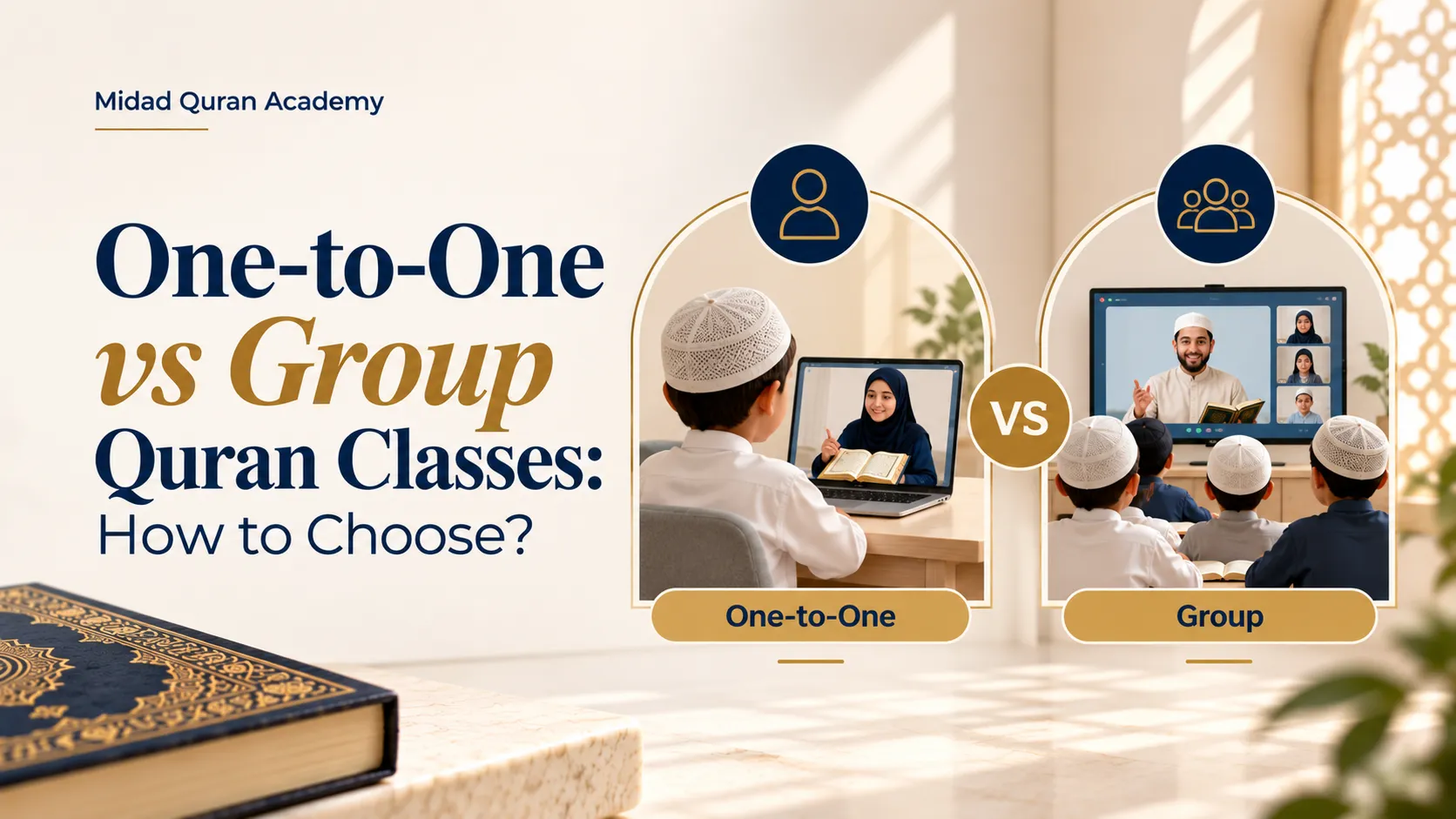
One-to-one Quran classes may be better suited to children who need individual correction, a personalised learning pace or extra support with a particular difficulty. Group classes can be a good choice for children who benefit from learning with others, shared activities and a connection to their local Muslim community.
Neither format is automatically better for every child.
The right choice depends on what your child needs to learn, how the lessons are organised and what kind of support they actually receive.
What Is the Difference Between One-to-One and Group Quran Classes?
In a one-to-one class, one teacher works directly with one learner. The lesson can focus on that learner's reading level, mistakes, questions and progress.
In a group class, several children learn within a shared session. The teacher organises activities and divides attention between learners.
But there is an important distinction.
A local madrasah is not necessarily the same as a group-only Quran class.
Some madrasahs bring children together in one classroom but listen to their Quran reading individually. Others teach shared lessons, organise children by level or combine both approaches.
Similarly, one-to-one teaching can happen online or in person.
This means parents should not make their decision based only on whether a class is online, at a mosque or in a private home.
The more useful question is:
How will my child actually spend their learning time?
Why Individual Attention Matters in Quran Reading
Imagine a child reading a Quranic word and repeatedly confusing two letters.
In a one-to-one lesson, the teacher can notice the difficulty immediately, explain the difference, demonstrate the correct pronunciation and let the child try again.
If the mistake continues, the teacher can spend more time on it before moving forward.
This is particularly helpful in Quran learning because reading and recitation involve skills that need to be heard, not simply checked on a written worksheet.
A child may recognise Arabic letters but struggle when joining them into words. Another may read fluently but consistently miss a Tajweed rule. A Hifz learner might remember new lessons while forgetting older Surahs.
These situations do not all require the same practice.
One-to-one teaching gives the teacher more opportunity to adjust the lesson around the learner's specific difficulty.
But individual attention should mean more than simply having a private video call.
The teacher still needs to listen carefully, explain clearly, correct with patience and check whether the learner can apply the correction.
A private lesson is valuable when the individual attention leads to meaningful learning.
What Can Children Gain from Group Quran Classes?
Group learning has strengths that should not be overlooked.
For many families, attending a local mosque or madrasah is part of their child's connection with the Muslim community.
Children may meet others their age, take part in shared activities and build relationships beyond the immediate Quran lesson.
Some programmes also combine Quran reading with Islamic Studies, Duas, Salah, Seerah and other subjects.
This wider environment can be valuable, particularly when parents want their children to participate regularly in community life.
These benefits are not merely assumptions. A UK qualitative study published in BMJ Open in 2026 reported parents describing the friendships, social connections and sense of identity their children experienced through madrasah participation.
The research reflects the experiences of its participants; it does not mean every madrasah provides the same experience.
Group learning can also give children opportunities to listen to one another, participate in shared discussions and become comfortable learning alongside peers.
For some children, that environment is encouraging.
The important point is whether the programme also provides enough suitable instruction for the child's particular Quran-learning goals.
One-to-One vs Group Quran Classes: A Practical Comparison
Here is how the two formats can differ.
| What matters | One-to-one classes | Group classes |
|---|---|---|
| Teacher attention | The teacher can focus on one learner throughout the session. | Teacher attention is shared, although individual listening may be included. |
| Reading correction | More opportunity for immediate, repeated correction. | Depends on group size, lesson structure and time for individual recitation. |
| Learning pace | Can be adjusted closely to the learner's current ability. | May follow a shared plan or groups organised by level. |
| Social learning | Limited peer interaction during the lesson. | May provide friendships, shared activities and community participation. |
| Timetable | Often arranged around individual availability. | Often follows fixed class days and times. |
| Cost | Dedicated teacher time may cost more per learner. | Shared teaching may reduce the cost per learner, depending on the programme. |
| Parent feedback | Easier to discuss one learner's specific progress, if the provider has a clear process. | Depends on assessments, teacher capacity and parent communication arrangements. |
This comparison describes common structural differences, not guaranteed results.
A well-organised group with a skilled teacher may serve a child better than an unstructured private lesson.
Equally, a child who needs frequent individual correction may benefit from a dedicated teacher even when their group programme is otherwise well organised.
The teaching method matters as much as the format.
What Does Educational Research Say?
Research on general school tuition offers a useful perspective, although it should not be treated as direct proof about Quran teaching.
The UK's Education Endowment Foundation has reviewed studies of both one-to-one tuition and small-group tuition.
Its findings indicate that both can support learning. They also highlight the importance of targeting instruction to learners' needs, providing effective feedback and using appropriately prepared teachers.
Research comparing the formats does not show that individual tuition is always superior in every situation.
These studies mainly concern subjects such as reading and mathematics. They do not establish the ideal class arrangement for Tajweed, Quran memorisation or Islamic Studies.
Nevertheless, they support a sensible educational principle:
The quality of teaching and how well it responds to a learner's needs matter more than the class label alone.
Parents can read the EEF's research summaries on one-to-one tuition and small-group tuition.
Which Format Might Suit Your Child?
Rather than choosing from advertisements alone, start by thinking about your child's current situation.
If Your Child Keeps Repeating the Same Quran Reading Mistakes
Suppose your child has been practising Quran reading but continues to confuse particular letters or reading signs.
They may benefit from more individual listening and targeted correction.
One-to-one tuition can provide that focused attention. A group programme with regular individual reading checks may also be suitable.
What matters is whether the teacher identifies the specific problem and gives the child enough opportunity to correct it.
If Your Child Enjoys Learning with Other Children
Some children are motivated by shared activities, familiar classmates and belonging to a regular learning community.
For them, a local madrasah or small-group programme may be a positive choice.
You should still ask how Quran reading is assessed individually, especially when children in the group are at different levels.
Learning alongside others and receiving personal correction do not have to be mutually exclusive.
If Your Child Needs a Different Learning Pace
Perhaps your child has already learned part of Noorani Qaida and does not need to restart every lesson.
Or they may require additional time on letter recognition while classmates are ready to move forward.
Individual instruction can make it easier to focus on their actual starting level.
A group programme may also accommodate this through level-based classes or individual learning plans.
Ask what happens when a learner progresses faster or slower than others.
If Your Family Needs Flexibility
School, homework, work commitments and family responsibilities can make fixed schedules difficult.
Online one-to-one learning may reduce travel and offer greater choice of class times, subject to teacher availability.
A nearby weekend madrasah may be more convenient for another family.
Compare the complete routine, not just the lesson itself.
A class that looks convenient on paper may become difficult to maintain if it regularly conflicts with the family's other commitments.
How Should Parents Compare the Cost?
Fees matter, particularly when more than one child in the family is learning.
Group Quran classes may offer a lower fee because a teacher works with several learners. One-to-one lessons involve dedicated teaching time, which may be priced differently.
But simply comparing two monthly fees can be misleading.
Before deciding which option offers better value, check:
- How many classes are included each month?
- How long is each class?
- Is Quran reading heard individually, and how often?
- Are Islamic Studies or other activities included?
- Are there additional admission, material or registration charges?
- Does the timetable create travel costs or other practical commitments?
It is also worth comparing the learning goals.
A parent paying for a broad community-based Islamic education programme may value things that are not included in a private Quran Reading lesson.
Meanwhile, a family seeking help with specific recitation difficulties may place greater value on dedicated correction.
The least expensive option is not necessarily the best value, and the most expensive option is not automatically the highest quality.
We should compare what each programme actually provides.
Can Online One-to-One and Local Madrasah Learning Work Together?
Yes. For some families, using both is a sensible arrangement.
A child might attend a local madrasah for community activities and broader Islamic education while receiving individual Quran Reading or Tajweed support online.
Another child may already receive enough personal correction at their madrasah and have no need for additional lessons.
The question is whether a second learning arrangement solves a real problem.
If two teachers are involved, it can help to explain what each is teaching and avoid giving the child conflicting or excessive practice assignments.
For example, one teacher may focus on Quran reading accuracy while the local programme provides Islamic Studies and shared activities.
That can work when the responsibilities are clear and the child has a manageable routine.
There is no need to enrol in multiple programmes simply because more classes appear better.
What About Safety and Parent Visibility?
Whether you choose private tuition, online learning or a group setting, your child should learn in an appropriate and responsible environment.
Parents should understand who is teaching their child, how supervision works and how concerns can be raised.
For families in England, the Department for Education's updated guidance on after-school clubs, tuition and community activities covers both supplementary religious education and private tutoring.
The guidance encourages parents to ask about safeguarding arrangements, staff suitability and supervision.
Families elsewhere in the UK or United States should check the relevant local requirements and ask equivalent safety questions.
For online classes, it is sensible to understand how meeting links, supervision, communication and access to the child are managed.
For in-person classes, parents may also want to know about supervision, collection arrangements and who is responsible for the children during sessions.
Neither online learning nor in-person group learning should be assumed safe purely because of its format.
Five Questions to Help You Make the Decision
Before enrolling your child, ask yourself:
What does my child need most right now? Individual reading correction, memorisation support, wider Islamic Studies or social learning?
How much individual attention will they actually receive? Ask the provider to explain the normal lesson, not simply the class size.
Will the teaching suit their current level? Find out what happens when the learner needs extra practice or is ready to move ahead.
Can our family maintain the routine? Consider the timetable, home practice, travel and total costs.
How will we know whether the arrangement is working? Look for clear feedback about actual learning, not only attendance or completed pages.
These questions should make the choice easier.
You do not need to find a programme that claims to do everything. You need one that can meet your child's most important learning needs responsibly.
How Midad Quran Academy Approaches Individual Learning
At Midad Quran Academy, we provide live, one-to-one online Quran classes for children and adults.
Our approach begins with understanding what the learner can already do and where they need support.
During lessons, the teacher works directly with the learner on reading, correction, practice and progression at an appropriate level.
We also recognise that local madrasahs and community programmes can provide valuable experiences beyond individual Quran instruction.
For families seeking more focused support, you can explore how Midad's one-to-one learning system works.
We offer three free trial classes before payment, allowing parents to observe the teaching approach and consider whether it is suitable for their child.
The Right Quran Class Is the One That Meets Your Child's Needs
One-to-one and group Quran classes are not opposing choices where one must always be right and the other wrong.
They offer different learning experiences.
A child who needs regular, detailed recitation correction may benefit from individual lessons. A child who enjoys shared learning and community activities may find a good local madrasah especially valuable.
And some children may benefit from a thoughtful combination of both.
The best decision begins with the learner, not the class format.
Understand what your child needs, ask how the teaching actually works and choose the arrangement that gives them a positive, sustainable way to learn the Quran.
