

Online Islamic Studies Classes for Children, Teenagers & Adults.
Study Quran translation and Tafseer, Islamic beliefs, worship, Seerah, Islamic history, character, and everyday Muslim life through live one-to-one lessons adapted to the learner’s age, current knowledge, and goals.
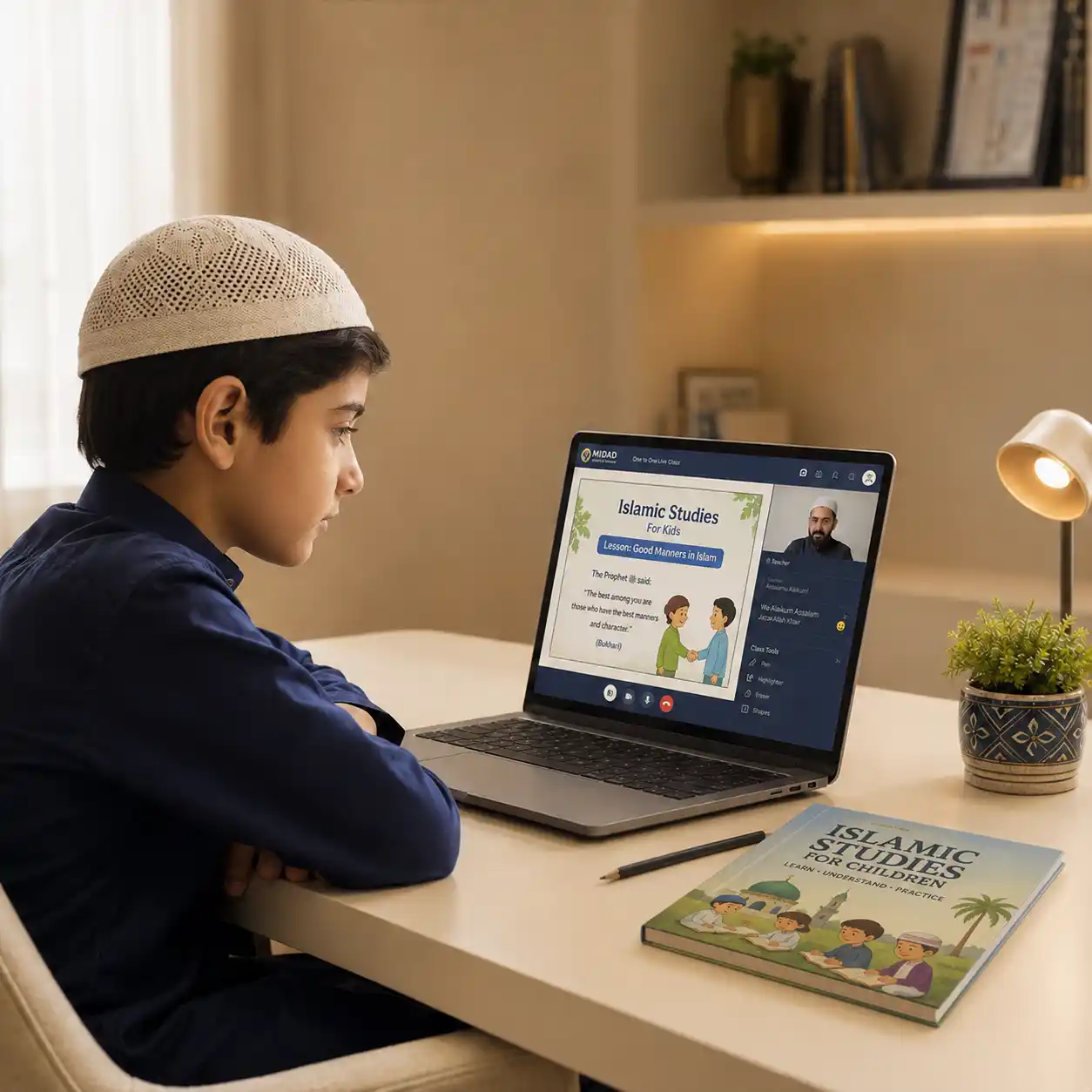 ISLAMIC LEARNING FOR REAL LIFE
Structured Islamic learning matched to the learner’s age, level, and questions.
One-to-one lessons in Quran meaning and Tafseer, beliefs, worship, Seerah, character, and daily Muslim life, adapted to the learner’s age and level.
ISLAMIC LEARNING FOR REAL LIFEIslamic Studies for Different Ages and Levels.
Some learners are starting with the basics. Others want to understand Quran meaning and Tafseer, strengthen their Islamic knowledge, or return to structured study. Lessons begin from what the learner already knows.
New to Islamic Studies
For learners who need a clear introduction to Islamic beliefs, worship, duas, Seerah, and everyday Muslim practice.
Quran Learners Seeking Meaning
For learners who read or recite the Quran and now want to understand translation, Tafseer, and the meaning behind what they recite.
Children & Teenagers
Age-appropriate lessons that connect Islamic learning to home, school, friendships, identity, and everyday choices.
Adult Learners
For adults who want to rebuild, organise, or deepen their understanding of Islam through structured one-to-one study.
Islamic Studies for Different Ages and Levels.
Some learners are starting with the basics. Others want to understand Quran meaning and Tafseer, strengthen their Islamic knowledge, or return to structured study. Lessons begin from what the learner already knows.
New to Islamic Studies
For learners who need a clear introduction to Islamic beliefs, worship, duas, Seerah, and everyday Muslim practice.
Quran Learners Seeking Meaning
For learners who read or recite the Quran and now want to understand translation, Tafseer, and the meaning behind what they recite.
Children & Teenagers
Age-appropriate lessons that connect Islamic learning to home, school, friendships, identity, and everyday choices.
Adult Learners
For adults who want to rebuild, organise, or deepen their understanding of Islam through structured one-to-one study.
Who Can Join?
The course is adapted to the learner’s age, current knowledge, and what they want to understand better.
New to Islamic Studies
Start with beliefs, worship, duas, Seerah, and everyday Muslim practice.
Build foundationsQuran Learners
Study Quran meaning, translation, and Tafseer alongside what you recite.
Understand the QuranChildren & Teenagers
Age-appropriate learning connected to home, school, identity, and daily life.
Learn at the right levelAdult Learners
Return to Islamic learning with a clear, structured one-to-one approach.
Build with structureQuran Meaning, Belief, Worship, Seerah & Daily Muslim Life.
The Islamic Studies course covers five connected areas. Topics are chosen and explained according to the learner’s age, current knowledge, and goals, from foundational Islamic learning to Quran meaning and Tafseer.
Quran Meaning & Tafseer
Study selected Quran passages through translation, clear explanation, context, and Tafseer suited to the learner’s level.
Meaning with contextBeliefs & Foundations
Build understanding of Allah, core Islamic beliefs, why Muslims worship, and how faith shapes everyday life.
Belief with understandingWorship & Duas
Learn the meaning and practice of salah, wudu, cleanliness, daily duas, and other essential acts of worship.
Worship with purposeSeerah & Islamic History
Study the life of Prophet Muhammad ﷺ, important events, and lessons from Islamic history with attention to meaning and application.
Lessons from historyCharacter & Daily Muslim Life
Explore honesty, patience, respect, responsibility, relationships, and how Islamic guidance applies to everyday situations.
Guidance for daily lifeQuran Meaning & Tafseer
Translation, clear explanation, context, and Tafseer suited to the learner’s level.
Beliefs & Foundations
Who Allah is, what Muslims believe, why we worship, and how faith guides life.
Worship & Duas
Salah, wudu, cleanliness, daily worship, and useful duas explained clearly.
Seerah & Islamic History
Lessons from the Prophet’s ﷺ life, key events, and Islamic history.
Character & Daily Muslim Life
Honesty, patience, respect, responsibility, relationships, and everyday choices.
Build Islamic understanding that the learner can explain, remember, and connect to real life.
What You Can Learn.
Five core areas, adapted to the learner’s age, level, and goals.
Clear topics with a purpose, not a random list of information.
Quran Meaning & Tafseer
Translation, clear explanation, context, and Tafseer suited to the learner’s level.
Beliefs & Foundations
Who Allah is, what Muslims believe, why we worship, and how faith guides life.
Worship & Duas
Salah, wudu, cleanliness, daily worship, and useful duas explained clearly.
Seerah & Islamic History
Lessons from the Prophet’s ﷺ life, key events, and Islamic history.
Character & Daily Muslim Life
Honesty, patience, respect, responsibility, relationships, and everyday choices.
One-to-One Teaching Built Around Understanding.
Each lesson focuses on a clear topic or Quran passage, explains it at the learner’s level, gives time for questions, connects it to real life, and checks understanding before moving forward.
Start With a Clear Focus
Each lesson begins with one topic, question, or passage so the learner knows exactly what is being studied.
Explain at the Right Level
The teacher uses clear language and examples suited to the learner’s age, current knowledge, and ability to follow the topic.
Ask and Discuss
The learner can ask questions, explain ideas back, and discuss points that need more clarity.
Connect It to Life
Quran meanings, beliefs, worship, Seerah, and character are connected to situations the learner can recognise.
Review and Build Forward
Important ideas return for review so understanding becomes stronger and the next lesson has a clear starting point.
A lesson should leave the learner with clearer understanding, not simply more information.
One-to-One Teaching Built Around Understanding.
Each lesson has a clear focus, age- and level-appropriate explanation, room for questions, real-life connection, and a review of what matters.
Start With a Clear Focus
Each lesson begins with one topic, question, or passage so the learner knows exactly what is being studied.
Explain at the Right Level
The teacher uses clear language and examples suited to the learner’s age, current knowledge, and ability to follow the topic.
Ask and Discuss
The learner can ask questions, explain ideas back, and discuss points that need more clarity.
Connect It to Life
Quran meanings, beliefs, worship, Seerah, and character are connected to situations the learner can recognise.
Review and Build Forward
Important ideas return for review so understanding becomes stronger and the next lesson has a clear starting point.
How One Islamic Studies Lesson Works.
Each lesson explains one clear idea, gives the learner room to ask and respond, connects it to real life, and reviews what matters.
Explain clearly. Let the learner think. Connect the lesson to life. Review what matters.
Teach One Idea Clearly
The teacher explains one topic or Quran passage at the learner’s level.
Check Real Understanding
Questions and discussion show what the learner understands and what needs more explanation.
Connect It to Daily Life
The lesson is linked to worship, family, work or school, relationships, character, or everyday choices.
Review and Build Forward
Key ideas are revisited so understanding becomes stronger and the next step stays clear.
Topic: Honesty → What does it mean? → Where can it affect a real decision? → What would the right choice look like?
Connect Islamic Learning to Everyday Life.
Islamic Studies becomes more useful when learners can see how beliefs and teachings shape worship, family life, relationships, work or school, character, and everyday decisions.
At Home
Explore respect, responsibility, gratitude, helping others, family relationships, and the manners Islam teaches at home.
In Worship
Understand the meaning behind salah, wudu, cleanliness, duas, remembrance, and consistent worship, not only the steps.
Character & Relationships
Apply honesty, patience, kindness, responsibility, good speech, and respect when dealing with other people.
School, Work & Community
Discuss how Islamic values can guide behaviour, friendships, responsibilities, and difficult situations outside the home.
Everyday Choices
Learn to recognise how Islamic guidance relates to ordinary habits, decisions, priorities, and conduct throughout the day.
Islamic knowledge matters more when the learner can understand where it belongs in real life.
Connect Islamic Learning to Everyday Life.
Islamic Studies becomes more useful when learners can see how beliefs and teachings shape worship, family life, relationships, work or school, character, and everyday decisions.
At Home
Explore respect, responsibility, gratitude, helping others, family relationships, and the manners Islam teaches at home.
In Worship
Understand the meaning behind salah, wudu, cleanliness, duas, remembrance, and consistent worship, not only the steps.
Character & Relationships
Apply honesty, patience, kindness, responsibility, good speech, and respect when dealing with other people.
School, Work & Community
Discuss how Islamic values can guide behaviour, friendships, responsibilities, and difficult situations outside the home.
Everyday Choices
Learn to recognise how Islamic guidance relates to ordinary habits, decisions, priorities, and conduct throughout the day.
Connect Learning to Daily Life.
The aim is not to keep Islamic knowledge inside a class. Learners should recognise where it guides everyday choices.
Family Life
Respect, gratitude, helping, speech, and responsibilities.
Daily Worship
Salah, wudu, duas, remembrance, intention, and consistency.
Character & Relationships
Honesty, patience, kindness, responsibility, and respect.
School & Work
Using Islamic values in school, work, relationships, and community life.
Everyday Decisions
Connecting Islamic guidance to ordinary habits and choices.
For Younger Learners, Parents Stay Informed.
When a child or teenager is enrolled, parents can see what was covered, what became clearer, what needs more attention, and what the teacher plans to work on next.
Lesson Covered
See which topic or Quran passage was studied in the lesson.
What Was Understood
Know what the learner understood clearly and where questions or gaps remain.
Home Follow-Up
Receive a simple point to review, discuss, practise, or revisit at home when useful.
Needs More Support
Topics that remain unclear stay visible so they can be explained or reviewed again.
Next Learning Step
Know what the teacher plans to revisit or build on in the next lessons.
Parents receive a short lesson note after class and a monthly progress update for younger learners.
For Younger Learners, Parents Stay Informed.
When a child or teenager is enrolled, parents can see what was covered, what became clearer, what needs more attention, and what the teacher plans to work on next.
Lesson Covered
See which topic or Quran passage was studied in the lesson.
What Was Understood
Know what the learner understood clearly and where questions or gaps remain.
Home Follow-Up
Receive a simple point to review, discuss, practise, or revisit at home when useful.
Needs More Support
Topics that remain unclear stay visible so they can be explained or reviewed again.
Next Learning Step
Know what the teacher plans to revisit or build on in the next lessons.
See What Your Child Is Learning.
For younger learners, parents can see what was covered, what needs more work, and what comes next.
The main topic or Quran passage studied in the lesson.
What became clear and where questions or gaps still remain.
A simple point to review, discuss, practise, or revisit at home.
What the teacher plans to revisit or build on next.
Islamic Studies Fees. Clear Monthly Plans.
Choose 2, 3, or 5 live one-to-one Islamic Studies classes per week and see the monthly fee in USD or GBP before you enrol. Start with three free trial classes. No payment before the trial.
3. Choose classes per week
30-minute live one-to-one classes5 Days / Week
Five 45-minute one-to-one classes each week for memorisation, revision, listening, and correction.
3 days per week · 30-minute one-to-one classes
Questions About Online Islamic Studies Classes.
Clear answers about who can join, course topics, Quran translation and Tafseer, one-to-one lessons, class length, parent updates, and the three free trial classes.
Children, teenagers, and adults can join from their current level. Lessons are adapted to the learner’s age, existing Islamic knowledge, questions, and learning goals.
Topics can include Quran translation and Tafseer, Islamic beliefs, worship and duas, Seerah, Islamic history, character, and guidance for everyday Muslim life.
Yes. Learners can study the meaning of selected Quran passages through translation, clear explanation, context, and Tafseer suited to their level and learning goals.
Yes. A learner can begin with the foundations or continue from previous Islamic learning. The starting point is based on what they already understand and what they want to learn next.
Yes. Classes are live and one-to-one, allowing the teacher to adjust the explanation, pace, questions, and lesson focus to the individual learner.
The topic may be similar, but the language, examples, depth, questions, and practical application are adjusted to the learner’s age and current understanding.
Yes. Questions and discussion are part of the lesson. The teacher can pause, explain a point differently, and check that the learner understands before moving forward.
Yes. Islamic Studies can be studied alongside Quran Reading, Tajweed, or Hifz when the learner wants to develop Quran skills and Islamic understanding together.
Parents receive a short lesson note after class and a monthly progress update covering what was studied, what needs more attention, and the learner’s next focus.
Standard Islamic Studies classes are 30 minutes. Current plans offer 2, 3, or 5 one-to-one classes per week, depending on the routine you choose.
The learner attends three live one-to-one classes before enrolment. You can experience the teaching, discuss the starting point and goals, and decide whether to continue. No payment is required before the trial.
Questions About Online Islamic Studies Classes.
Clear answers about who can join, course topics, Quran translation and Tafseer, one-to-one lessons, class length, parent updates, and the three free trial classes.
Children, teenagers, and adults can join from their current level. Lessons are adapted to the learner’s age, existing Islamic knowledge, questions, and learning goals.
Topics can include Quran translation and Tafseer, Islamic beliefs, worship and duas, Seerah, Islamic history, character, and guidance for everyday Muslim life.
Yes. Learners can study the meaning of selected Quran passages through translation, clear explanation, context, and Tafseer suited to their level and learning goals.
Yes. A learner can begin with the foundations or continue from previous Islamic learning. The starting point is based on what they already understand and what they want to learn next.
Yes. Classes are live and one-to-one, allowing the teacher to adjust the explanation, pace, questions, and lesson focus to the individual learner.
The topic may be similar, but the language, examples, depth, questions, and practical application are adjusted to the learner’s age and current understanding.
Yes. Questions and discussion are part of the lesson. The teacher can pause, explain a point differently, and check that the learner understands before moving forward.
Yes. Islamic Studies can be studied alongside Quran Reading, Tajweed, or Hifz when the learner wants to develop Quran skills and Islamic understanding together.
Parents receive a short lesson note after class and a monthly progress update covering what was studied, what needs more attention, and the learner’s next focus.
Standard Islamic Studies classes are 30 minutes. Current plans offer 2, 3, or 5 one-to-one classes per week, depending on the routine you choose.
The learner attends three live one-to-one classes before enrolment. You can experience the teaching, discuss the starting point and goals, and decide whether to continue. No payment is required before the trial.
Questions Before You Begin.
Quick answers about who can join, what you can study, one-to-one lessons, and the free trial.
Children, teenagers, and adults can join. Lessons are adapted to age, level, and learning goals.
Quran meaning and Tafseer, beliefs, worship and duas, Seerah, Islamic history, character, and daily Muslim guidance.
Yes. Selected Quran passages can be studied through translation, clear explanation, context, and Tafseer suited to the learner’s level.
Yes. Each class is live and one-to-one, so the teacher can adjust the explanation, pace, and questions to the learner.
Join three free one-to-one classes before enrolment, experience the teaching, discuss the starting point, and decide whether to continue. No payment is required before the trial.
Try MIDAD’s Islamic Studies Classes Before You Enrol.
Book three free one-to-one trial classes. Experience the teaching, discuss the learner’s goals, and see how the course can be adapted to their age, current knowledge, and areas of interest.
Tell us whether the learner is beginning with the basics, wants Quran meaning and Tafseer, or needs a broader Islamic Studies plan. We’ll help identify a suitable starting point.
Try Islamic Studies Before You Enrol.
Join three free one-to-one Islamic Studies classes, experience the teaching, and discuss a suitable starting point before deciding whether to continue.
Experience the teaching first. Decide after the trial.
Try Islamic Studies Before You Enrol.
Join three free one-to-one classes, experience the teaching, and discuss a suitable starting point before you decide.
Experience the teaching first. Decide after the trial.